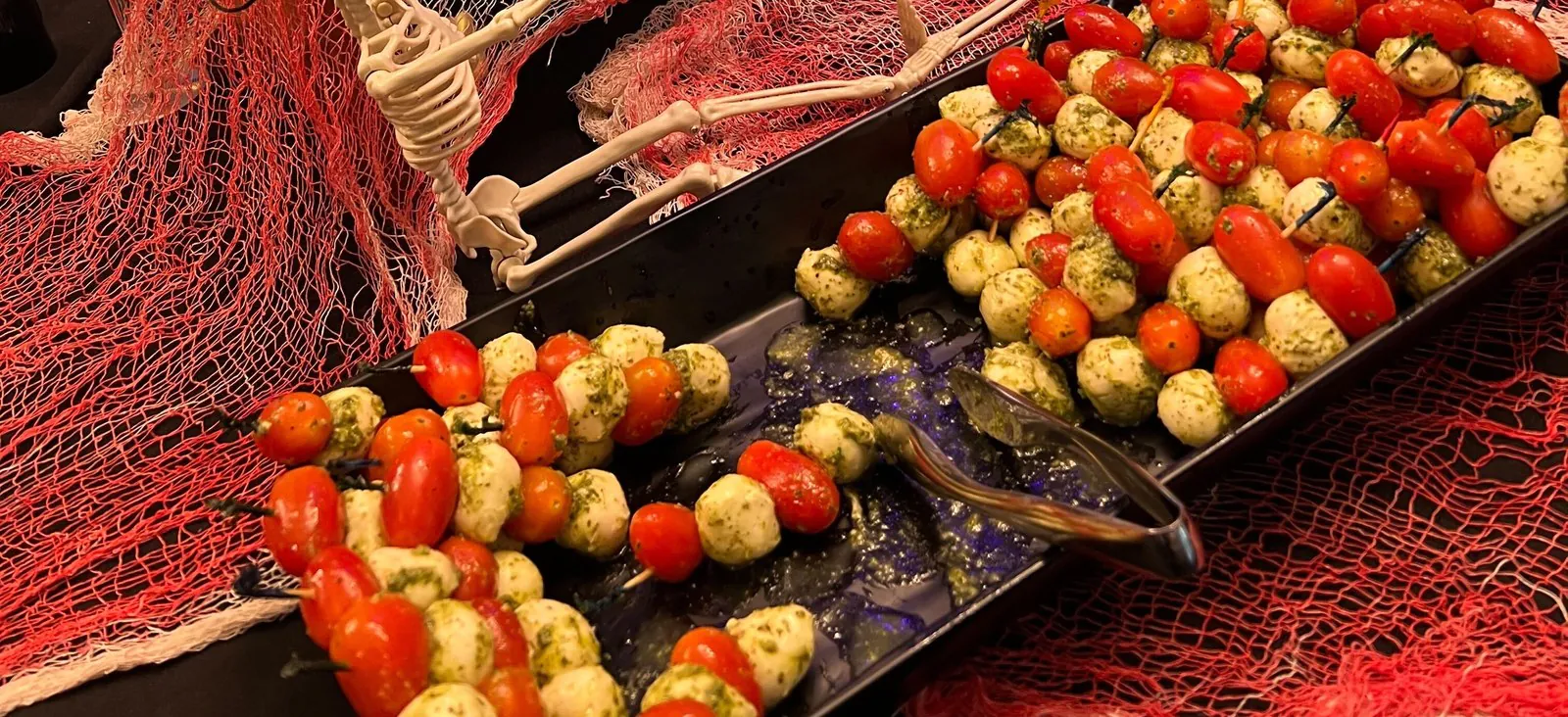
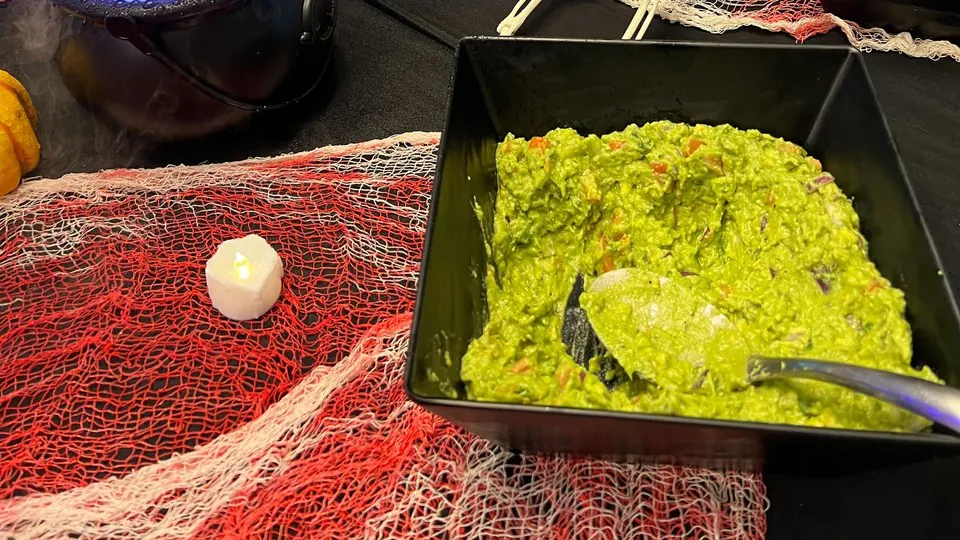
The costume parade starts at three, and two kinds of food sit on the table. One is the spread you ordered: caprese skewers, a bowl of guacamole, a tray of cookies. The other is a bowl of fun-size candy that somebody tipped out of a grocery bag at lunch. The bag went into the recycling on their way back to their desk.
That bag carried the only complete label the candy had. A colleague who reads labels before eating now faces a pile of small wrappers with no ingredient list on them. This guide follows the label: where federal rules put it on a bag of candy, why the small size can differ from the full-size bar, and how to set the table so the information stays with the food.
In this guide
- The label lives on the bag
- The fun-size bar is its own product
- Nine allergens, two ways to name them
- The line nobody has to print
- Two bowls on the table
- What to ask your catering partner
- Order the rest around the table
This page reads food labeling rules and a food allergy charity’s advice. It gives no medical advice, and it cannot tell anybody what they can eat. The person who reads the label makes that call. Your job as the host is to keep the label within reach. For menu ideas and budgets, our Halloween catering page covers the themed lunch and the treat table, and our office Halloween decor ideas cover the room.
The label lives on the bag
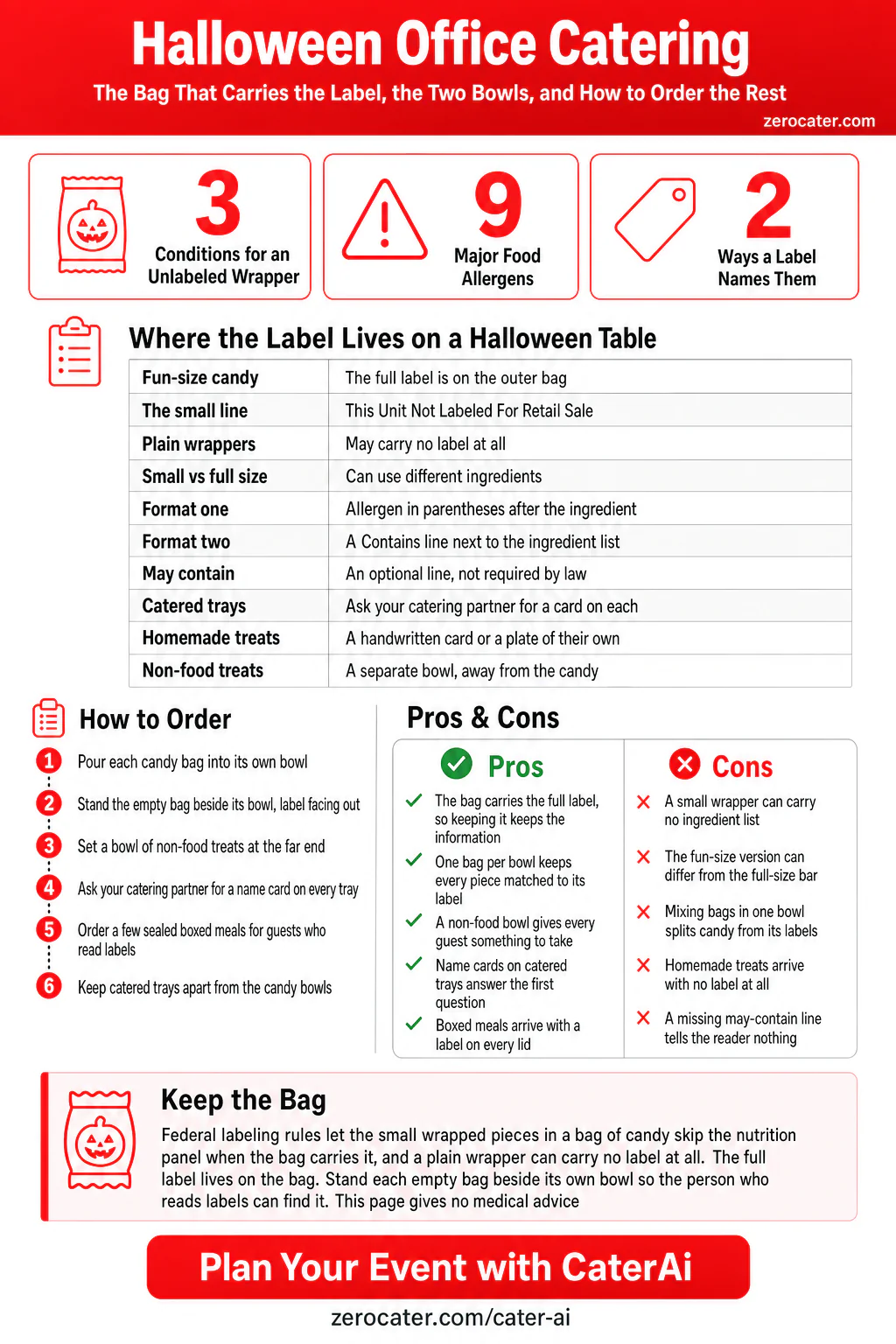
Federal nutrition labeling rules sit in 21 CFR 101.9, and paragraph (j) lists the foods that can skip the Nutrition Facts panel. Item (j)(15) covers “the unit containers in a multiunit retail food package”. That is the regulator’s name for the small wrapped pieces inside a bag of candy, and the paragraph sets three conditions.
First, the outer package carries all the nutrition information the section requires. Second, the pieces are “securely enclosed within and not intended to be separated from the retail package under conditions of retail sale”. Third, each piece carries the statement “This Unit Not Labeled For Retail Sale”, in type “not less than 1/16-inch in height”.
The third condition has an exception of its own. The statement “shall not be required when the inner unit containers bear no labeling at all.” A wrapper with a brand name on it gets the small line. A plain wrapper can carry nothing.
| Condition in (j)(15) | What the rule says | What it means at the office table |
|---|---|---|
| One: the outer package | The multiunit package carries all the nutrition information the section requires | The full panel is on the bag |
| Two: the pieces stay inside | The units are “securely enclosed within and not intended to be separated from the retail package under conditions of retail sale” | The rule pictures the pieces in the bag. A bowl separates them |
| Three: the small line | Each unit says “This Unit Not Labeled For Retail Sale”, in type not less than 1/16-inch tall | The wrapper points you back to the bag |
| The exception to three | The line is not required when the inner units “bear no labeling at all” | A plain wrapper can carry nothing |
Read the second condition again. The rule pictures the pieces staying inside the bag until the bag reaches a home. An office bowl ends that picture at the first handful. The information stays with the bag, and the bag stays at the party only if you keep it there.
Paragraph (j)(15) governs the nutrition panel. Ingredient lists and allergen statements come from other rules, and a food allergy charity describes what people find in practice: some miniature candy items “may not have labels”. Under any of those rules, the bag is the one package on the table that was written to be read.
Three conditions, one small line. The rule lets a fun-size wrapper say “This Unit Not Labeled For Retail Sale” in letters one-sixteenth of an inch tall, or say nothing at all. The full label is on the bag.
The fun-size bar is its own product
FARE (Food Allergy Research & Education), the charity behind the Teal Pumpkin Project, puts the second problem in one sentence: “Many miniature or fun-size versions of candy items contain different ingredients than their full-size counterparts.”
Your colleague who has eaten the full-size bar for years has read the full-size label. The small piece in the bowl comes from a different product with its own ingredient list, and that list appears on the bag it came in. Apply the same caution to any version you have not read before, including a shaped or seasonal one: read that product’s bag.
So the host keeps two things for each bowl. One is the bag. The other is a clear link between the bag and the bowl it filled.
Nine allergens, two ways to name them
FDA names nine major food allergens: milk, eggs, fish, Crustacean shellfish, tree nuts, peanuts, wheat, soybeans and sesame. Sesame is the newest of the nine. The FASTER Act added it to the list.
A packaged food can name the food source of a major allergen in two ways. It can put the source in parentheses after the ingredient, as in “lecithin (soy)”. It can also print a “Contains” statement immediately after or next to the ingredient list, as in “Contains wheat, milk, and soy”. A bag can use either format, so the reader checks both the list and the line below it. That is a job for the person who reads the bag, and it needs the bag on the table.
| Format | Where it sits | Example FDA gives |
|---|---|---|
| In parentheses | After the ingredient name, inside the ingredient list | “lecithin (soy)” |
| A “Contains” statement | Immediately after or next to the ingredient list | “Contains wheat, milk, and soy” |
| An advisory line (not one of the two) | Anywhere on the package, if the maker chooses to print it | “may contain” or “produced in a facility that also uses” |
The line nobody has to print
Many bags carry a third kind of line: “may contain”, or “produced in a facility that also uses”. FDA says advisory statements like these are “not required by law”. A manufacturer may use one to address unavoidable cross-contact, and FDA says the statement “must be truthful and not misleading.”
Two things follow for the host. A line on the bag is information that the reader gets to weigh. A bag with no such line tells the reader nothing either way. You do not need to interpret either case, and you should not try. Put the bag out and let the person who needs it read it.
Two bowls on the table
The Teal Pumpkin Project began as a local awareness activity run by the Food Allergy Community of East Tennessee, and FARE runs it as a campaign. A teal pumpkin on a doorstep means the house has non-food treats, “such as glow sticks or small toys”. FARE’s advice to hosts is short: keep food treats and non-food treats in “separate bowls”.
An office table can borrow the whole idea.
- One bag, one bowl. Pour each bag into a bowl of its own and stand the empty bag beside it, ingredient panel facing out. Three bags tipped into one bowl separate every piece from its label.
- A teal bowl with no food in it. Stickers, glow sticks, enamel pins, small puzzles, or raffle tickets for the costume prize. Put it at the far end of the table from the candy, so hands do not travel from one bowl to the other.
- A card for anything without a bag. Homemade cookies from the potluck have no label at all. Ask the baker to write a card that lists what went in, or give homemade treats a plate of their own. Our office potluck guide covers the rest of that table.
- Catered trays in their own zone. The catered food has its own source of information, your catering partner. Keep the trays apart from the candy bowls so a stray wrapper or a handful of crumbs does not travel between them.
| Food on the table | Where its information sits | What stays on the table |
|---|---|---|
| Fun-size candy from a bag | The outer bag | The empty bag, standing beside its own bowl |
| A full-size bar | Its own wrapper | The wrapper |
| A shaped or seasonal version of a candy you know | That product’s own bag | That bag, even if you know the regular one |
| Catered trays | Your catering partner | A name card on each tray |
| Homemade potluck treats | The person who baked them | A handwritten card, or a plate of their own |
| Non-food treats | No food label to keep | A separate bowl at the far end from the candy |
What to ask your catering partner
The catered half of the table has a source you can call before the party. Ask for what you need when you place the order.
- A name card on every tray. A card that names the dish and its main ingredients answers the first question before anybody has to ask it.
- Ingredient information on request. When a guest asks about a dish, pass the question to your catering partner and pass the answer back. Do not answer it from memory.
- Some sealed portions. A few individually packed meals give a guest who reads labels a portion with its own container and its own label. Our guides to boxed lunches for food allergies and catering for mixed dietary needs cover how to order them.
- Desserts packed on their own. Themed cookies and cupcakes travel best in their own containers, apart from the savory trays.
For a longer read on the office side of food allergies, see catering to people with food allergies at work.
Plan Halloween catering with CaterAi
Order the rest around the table
With the labels handled, the order itself gets simpler. Three formats keep information attached to the food by design.
Boxed meals put one meal in one container with a label on the lid. For a lunch-hour costume contest, boxed meal catering gives each guest a sealed portion.
Party trays with a card on each suit a table that runs through the afternoon. Our party tray guide covers sizes and mixes, and the finger food guide covers the bites that work between conversations.
A grazing table turns the whole spread into one long display. Our grazing table guide covers the layout. Give each board its own card, and keep the candy bowls at their own end.
For themed desserts, the dessert catering menus list partners by city. Halloween opens the fall run of office holidays, and the holiday catering directory carries the next ones, from Diwali to Thanksgiving.
Where Zerocater fits
Zerocater handles the catered half of the table. For ongoing corporate catering, Zerocater manages the rotation across a network of local catering partners, and how it works explains the ordering side. For a one-off party, CaterAi drafts a menu from a plain description of the event. Tell it the time of the costume contest, the headcount, and that some guests read labels, and ask for labeled trays and a few sealed portions.
The candy bag stays with you. Stand it next to its bowl, and the label goes wherever the candy goes.
Plan Halloween catering with CaterAi
Frequently Asked Questions
Why do some fun-size candy wrappers have no ingredient list?
The small wrapped pieces inside a bag are sold as part of the bag. The federal nutrition labeling rule, 21 CFR 101.9(j)(15), lets those unit containers skip the Nutrition Facts panel when the outer package carries it, when the units are “not intended to be separated from the retail package”, and when each unit says “This Unit Not Labeled For Retail Sale”. That last line is not required when the inner units “bear no labeling at all”. FARE, the food allergy charity, notes that some miniature candy items may not have labels. The bag is the package written to be read, so keep it.
Is a fun-size candy bar the same as the full-size bar?
Not always. FARE says “many miniature or fun-size versions of candy items contain different ingredients than their full-size counterparts”. A person who knows the full-size label has read a different product. The ingredient list for the small version is on the bag it came in.
What does “This Unit Not Labeled For Retail Sale” mean on a wrapper?
It is the statement 21 CFR 101.9(j)(15) asks for on a small unit inside a multi-unit package, in type not less than 1/16-inch tall. It tells you the piece was meant to stay inside the package that carries the full nutrition label. The word “individual” can appear in the statement too.
Does “may contain” on a candy bag mean the candy contains that allergen?
The line is an advisory statement. FDA says such statements are “not required by law” and that a manufacturer may use one to address unavoidable cross-contact, as long as it is truthful and not misleading. A line on the bag is information for the reader to weigh. A bag without one tells the reader nothing either way. Leave the bag out so the person who needs it can read it.
What is the Teal Pumpkin Project?
It is a campaign run by FARE (Food Allergy Research & Education). A teal pumpkin, or a teal pumpkin sign, means the host has non-food treats such as glow sticks or small toys. FARE suggests keeping food treats and non-food treats in separate bowls. The project grew from a local awareness activity run by the Food Allergy Community of East Tennessee.
How should an office set up the candy table for Halloween?
Pour each bag into its own bowl and stand the empty bag beside it. Put a bowl of non-food treats at the far end, away from the candy. Give homemade treats a handwritten card or a plate of their own. Keep the catered trays apart from the candy bowls, with a name card on each tray.