Feast from the East cooks out of one kitchen on Westwood Boulevard in West Los Angeles, and it has sold the same Chinese Chicken Salad from its first year of trading. The catering offer fits on a single page: four sections, twenty-four rows, and the same four pan names running across all of them.
The menu states its yields once per section, and one of those four section lines does something the other three do not. It tells you how many people a pan feeds as a meal, and separately how many it feeds as a side. Read those two numbers against each other and you have the key to every other pan on the menu.
In this guide
- The one row that names a main course
- One main equals two sides, stated four times
- What the ratio does to the rest of the menu
- Why the rice pan covers more people than the entree pan
- The pan names are labels, not quantities
- The appetizer block changes units
- Changing the protein leaves the headcount alone
- What Feast from the East sends to an office
- How to order
A Westwood kitchen built on two dishes
Suzanne Toji and Steve Sumii opened Feast from the East in 1981 as a small storefront on Westwood Boulevard, serving a mix of Japanese and Chinese dishes alongside two items that did most of the work: a Chinese Chicken Salad and a sesame chicken. Word travelled around West Los Angeles on the salad. Toji took sole ownership in 1986.
The room grew around the food. A dining annex went in at the end of the eighties and gave way to two larger storefront rooms a decade after that, with two interior refits following. In 1990 Toji started bottling the sesame dressing and selling it through independent grocers, and that dressing line has since widened into several varieties and a range of salad toppings carried by warehouse clubs and specialty grocers across Southern California.
The kitchen has stayed at the same address the whole time, and it still leads with the two dishes it opened on. That matters for an office order, because the catering menu is built around them rather than bolted on beside them.
The one row that names a main course
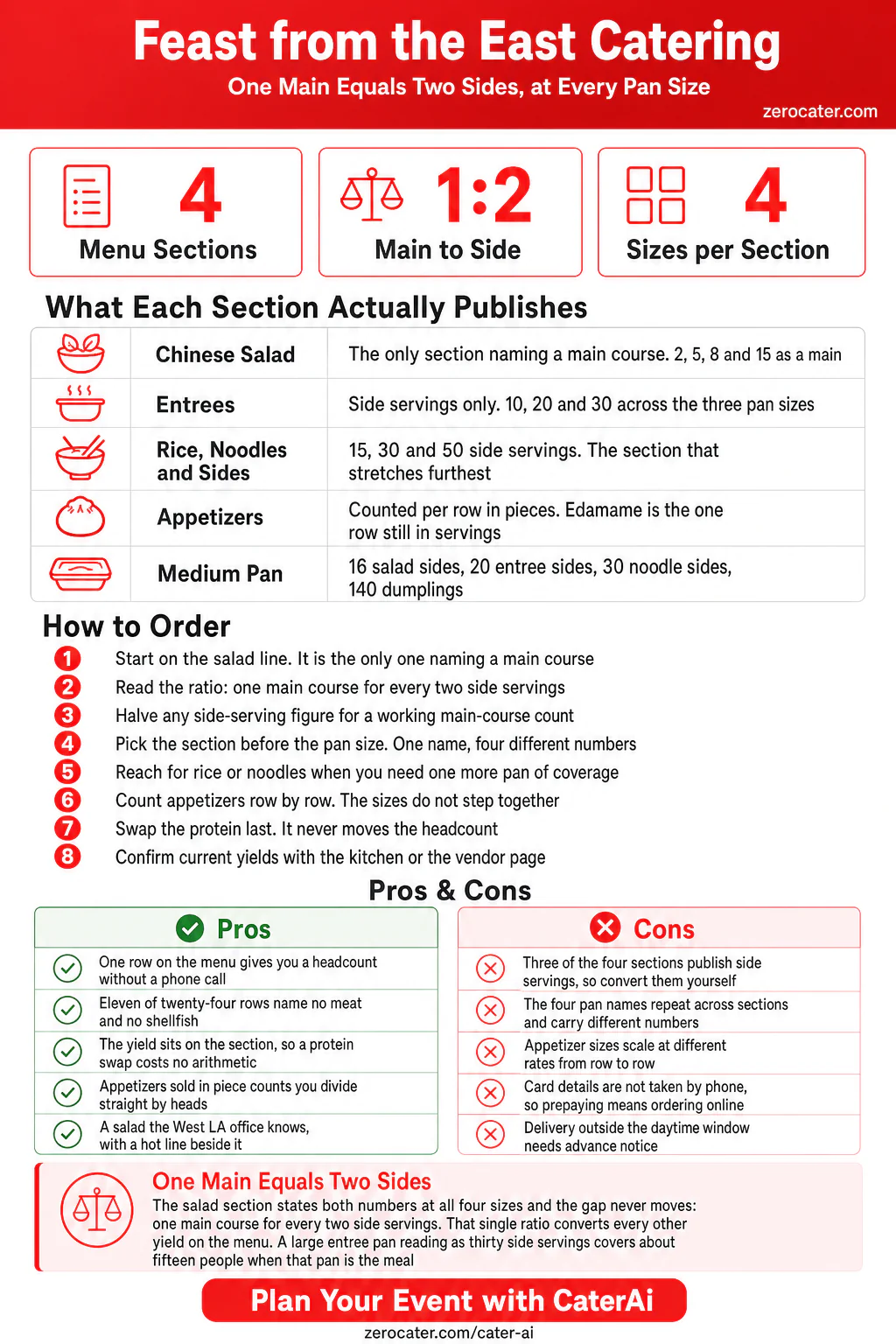
The catering menu splits into four sections, and each section prints its yield once, on the line above its dishes. Three of those four lines give you a single number. The fourth gives you two.
| Section | Family Size | Small Pan | Medium Pan | Large Pan |
|---|---|---|---|---|
| Chinese Salad | 2 main or 4 side | 5 main or 10 side | 8 main or 16 side | 15 main or 30 side |
| Entrees | 2 to 3 servings | 10 side servings | 20 side servings | 30 side servings |
| Rice, Noodles & Sides | 2 to 4 servings | 15 side servings | 30 side servings | 50 side servings |
| Appetizers | counted per row, in pieces | counted per row, in pieces | counted per row, in pieces | counted per row, in pieces |
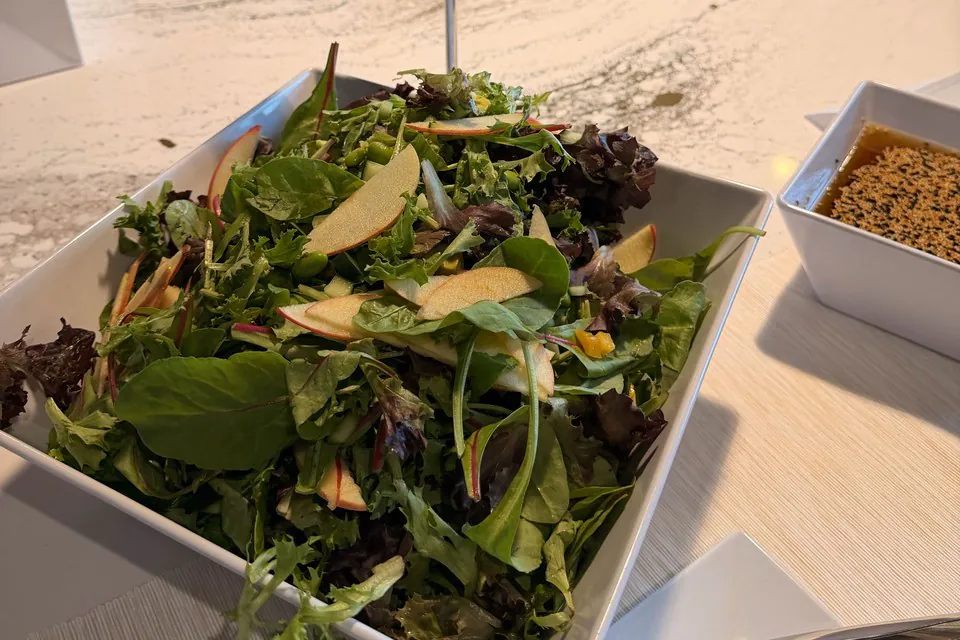
The salad line is the one that names a main course, and it is one section of the four. Everywhere else the menu tells you how far a pan goes as a side dish and leaves the meal question to you. That is a normal way to write a catering menu. What is less normal is that the salad line also hands you a ratio, and that ratio reads the rest of the page.
One main equals two sides, stated four times
Set the salad’s two numbers side by side at every size and the gap between them never moves.
| Size | As a main | As a side | Ratio |
|---|---|---|---|
| Family Size | 2 | 4 | 1 to 2 |
| Small Pan | 5 | 10 | 1 to 2 |
| Medium Pan | 8 | 16 | 1 to 2 |
| Large Pan | 15 | 30 | 1 to 2 |
The kitchen has stated the same relationship at every one of the four sizes, with no rounding and no drift: one main course for every two side servings. Across all four sizes the arithmetic is exact. A pan that covers thirty people beside two other dishes covers fifteen when it is the only thing on the plate.
That ratio is the sentence to carry into the rest of the menu.
What the ratio does to the rest of the menu
The entree section and the rice and noodle section both publish side servings. Apply the salad’s ratio to those figures, halving each one, and you get a working main-course count for a pan the menu never described that way.
| Size | Entrees, as printed | Entrees, converted | Rice and noodles, as printed | Rice and noodles, converted |
|---|---|---|---|---|
| Small Pan | 10 side servings | about 5 as a main | 15 side servings | about 7 or 8 as a main |
| Medium Pan | 20 side servings | about 10 as a main | 30 side servings | about 15 as a main |
| Large Pan | 30 side servings | about 15 as a main | 50 side servings | about 25 as a main |
A large entree pan that reads as thirty side servings covers about fifteen people if that pan is the meal. A small one covers about five. Those are planning numbers rather than the kitchen’s own figures, because the ratio belongs to the salad line. Use them to shortlist a pan size, then confirm the current yields with the kitchen or from the vendor page before the order goes in.
Why the rice pan covers more people than the entree pan
Compare the two side-only sections at the same pan name and the starch wins every time, by a margin that grows at the top of the range.
- Small Pan. 15 side servings of rice or noodles against 10 of an entree, which is one and a half times as far.
- Medium Pan. 30 against 20, again one and a half times as far.
- Large Pan. 50 against 30, which is one and two thirds times as far.
The first two sizes hold that ratio at three to two. The largest size opens it to five to three. If your headcount lands between two pan sizes and you want one more pan rather than a bigger one, a large rice or noodle pan buys more coverage per pan than a large entree pan does.
The pan names are labels, not quantities
The same four names run across the page, so it is tempting to read them as sizes. Track one of them down the menu instead. Medium Pan means:
- 16 side servings of salad
- 20 side servings of an entree
- 30 side servings of rice or noodles
- 140 dumplings
- 50 spring rolls
That is five different numbers behind one name. The name tells you which column to look in. The line above the dishes tells you what you are actually buying, and it is the line worth reading twice.
The appetizer block changes units
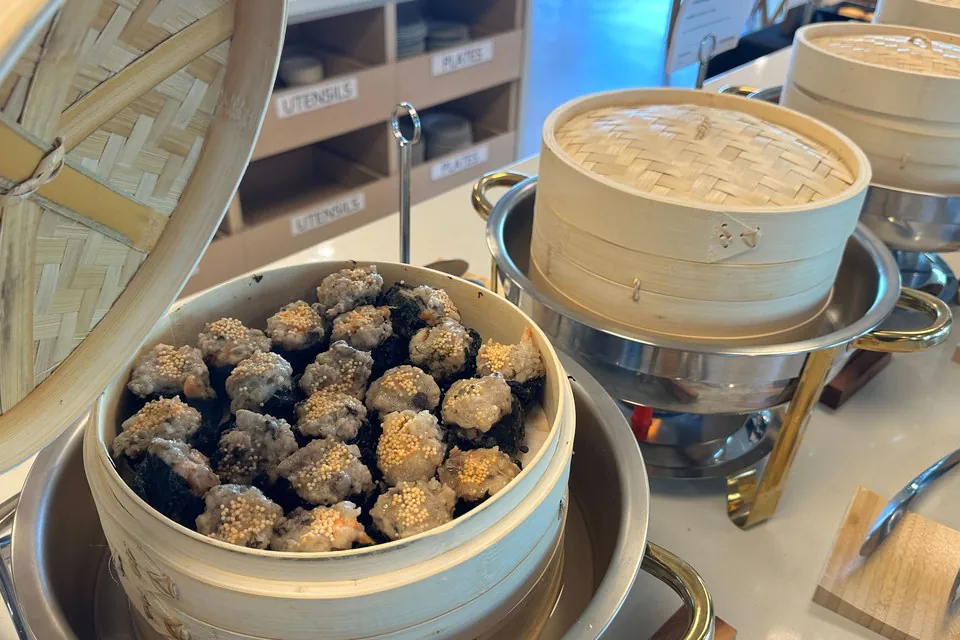
The first three sections of the menu talk in servings. The appetizer block switches to a count of things you can see: five of its six rows carry a piece count at every size. The exception is edamame, which stays in servings, and it is the only row in the block that does.
A piece count is the easiest number on the whole menu to plan against, because you divide it by heads and stop. It needs care in one place: the sizes do not step together. Measure each row from its smallest size to its largest:
- Sesame chicken: 18 to 72, which is four times as many
- Vegetable Dumpling: 20 to 200, which is ten times as many
- Vegetable Springrolls: 12 to 80, which is nearly seven times as many
- Chicken Potstickers: 20 to 200, which is ten times as many
- Edamame: 8 to 65, which is just over eight times as many
- Teriyaki Meatballs: 15 to 140, which is nine and a third times as many
The sesame chicken row multiplies by four across the four sizes. The vegetable dumpling row multiplies by ten. Both sit under the same four headings. Sizing an appetizer spread by picking the same column for each row gives you a very different quantity of one thing than another, so count the pieces per row and let the columns fall where they fall.
Changing the protein leaves the headcount alone
The yield line sits on the section, not on the dish. Every row inside a section shares it. The chicken salad and the plain salad carry one spec between them. Plain, chicken and shrimp fried rice carry one spec between the three of them. Beef chow mein and chicken chow mein carry the same one.
Across the three sections that publish a section-level yield, all eighteen rows work this way. The practical effect is that protein is a taste and budget decision and never a headcount decision. You can settle the pan sizes first, then swap a shrimp row for a chicken row the day before, and none of your arithmetic moves.
The same structure makes the meat-free reading quick. The menu names eleven of its twenty-four rows with no meat and no shellfish in the title, and they land in all four sections, so a vegetarian guest is choosing across the menu rather than from one corner of it. That is a count of what the menu calls things. The kitchen publishes a statement that trace amounts of common allergens are present across its dishes, so confirm the current preparation with the kitchen before you order for a specific requirement. Nothing here is dietary or medical advice.
What Feast from the East sends to an office
The shape of the menu suits an office lunch better than most single-kitchen catering lists, because each section does one job.
- The salad, in two builds. One with chicken, one without, and the row that tells you how many people it feeds either way. This is the dish the kitchen is known for and the easiest one to size.
- Five hot entrees. A vegetable stir fry and four sauced or grilled proteins, sold by the pan.
- Eleven rice, noodle and side rows. Fried rice, chow mein, pad thai and soba, plus plain rice and steamed vegetables, all on the section that stretches furthest per pan.
- Six appetizer rows. Fried, steamed and cold options, sold in counts you can divide by heads.
The kitchen also answers a short set of its own questions in public, and two of the answers are worth an office planner’s time. It states that trace amounts of common allergens run through its dishes rather than implying a guarantee it cannot make, and it says plainly that it will not take card details over the phone. Both are the kind of thing most operators leave you to discover at the point of ordering.
Who it is ideal for
A West Los Angeles team that wants a light, salad-led lunch and a hot line from one kitchen, without running two orders. Teams around Westwood, Century City and the wider Los Angeles office corridor are inside the natural delivery range. It also suits the planner who wants to size a lunch from published numbers rather than a phone call, which is exactly what the salad row makes possible.
It is a weaker fit for a room that needs every dish individually portioned on arrival. For that shape of event, a boxed lunch vendor does the job with less handling, and a seated lunch-and-learn has its own constraints.
How to order Feast from the East catering
Direct. The kitchen publishes the one-page catering menu on its own site and takes orders through its online ordering platform or over the phone. Card details are declined by phone, so prepaying means ordering online. It runs its own catering delivery through a daytime window and asks for advance notice to go outside it.
Through Zerocater. The Feast from the East vendor page carries the current menu and a live quote, and the order lands in the same place as every other vendor your office uses. That matters once a lunch becomes a programme rather than an event. How it works covers the rest.
Feast from the East and Zerocater
Feast from the East is good at a specific thing: a salad the office already knows, a hot line beside it, and a menu you can size without picking up the phone. For a single lunch that is the whole job, and ordering direct is a sensible route.
A weekly rotation asks a different question. The salad that landed well in week one is the salad your team has seen four times by the end of the month, and the sizing work starts again with every vendor you add. Zerocater’s Los Angeles network puts Feast from the East alongside other Chinese caterers in the city and the wider Los Angeles vendor list, so the rotation is a setting rather than a project.
CaterAi takes the headcount, the dietary requirements and the room, and builds the order across vendors. It is the part that stops you resizing the same order every week. Teams running the same problem elsewhere in the city have written it up in our Los Angeles office catering cost guide, and the same sizing habits carry over to a board meeting or a tech company all-hands.
Plan your team lunch with CaterAi
Menu structure, section yields and piece counts in this guide are read from the catering menu Feast from the East publishes on its own site, and the conversions are ours rather than the kitchen’s. Confirm the current menu, yields and availability, and take a live quote, from the Feast from the East vendor page. Nothing here is dietary or medical advice.
Feast from the East Catering: Frequently Asked Questions
How many people does a pan of Feast from the East catering feed?
It depends on which section of the menu the pan comes from, and the menu states it per section rather than per dish. The salad section gives two figures at every size, a main-course count and a side count. The entree section and the rice and noodle section give a side-serving count only. The appetizer rows give a piece count. Read the line above the prices for the section you are ordering from, then take the live figures from the Feast from the East vendor page.
Does the catering menu say how many people an entree pan feeds as a main course?
Not directly, and it does not need to. The salad section publishes both numbers at all four sizes, and the gap between them is the same every time: one main course for every two side servings. Apply that ratio to an entree pan’s side-serving figure and you have a working main-course estimate. Treat it as a planning number, confirm the current figures with the kitchen, and size up if the room skews hungry.
Does Feast from the East have vegetarian catering options?
The catering menu names eleven rows with no meat and no shellfish in the title, spread across the salad, entree, rice and noodle, and appetizer sections. That is a count of what the menu calls things, not a dietary guarantee. The kitchen publishes a statement that trace amounts of common allergens are present across its dishes, so call with the specific requirement before you order for someone who needs one.
Can Feast from the East handle gluten or allergy requirements?
The kitchen answers this in its own published questions and answers, and the answer is worth reading before you order. It says it will make an effort on request, and it declines to describe any dish by the federal gluten-free standard. It also states that trace amounts of common allergens are present across its dishes. Publishing the limit rather than implying a guarantee is the useful answer for an office order. Call the kitchen with the specific request. Nothing here is dietary or medical advice.
How do you order Feast from the East catering?
Two routes. Direct, through the kitchen’s own online ordering site or by phone, with the one-page catering menu as your reference. The kitchen declines card details over the phone, so ordering online is the route if you need to prepay. Or through Zerocater, where the Feast from the East vendor page carries the current menu and a live quote, and the order sits alongside every other vendor your office uses.
Is Feast from the East a good fit for an office lunch?
It fits a team that wants one kitchen to cover both a light, salad-led lunch and a hot line, from a West Los Angeles address. The salad row gives you a headcount you can trust without a phone call, the rice and noodle pans stretch the furthest per pan, and the appetizer rows are sold in counts you can divide by heads. For a recurring program across several vendors, CaterAi plans the rotation.