Curryous cooks Fijian-Indian food out of one San Francisco kitchen, and the menu is bilingual. Indian words and Fijian words sit on the same list, and both get used the way a working kitchen uses them, as the name of a thing. One of those words is an ingredient, and that is where this menu becomes easy to read.
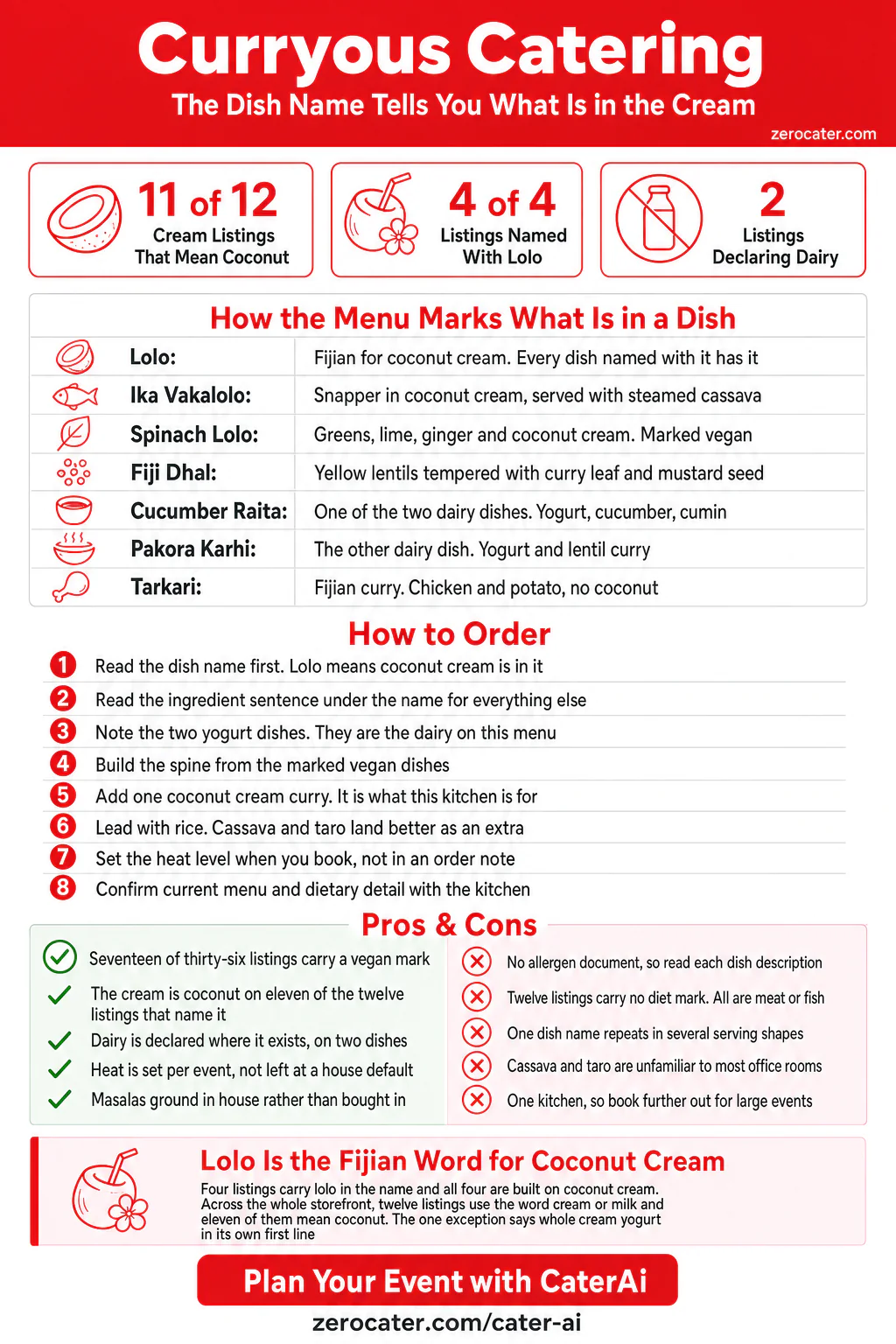
The word is lolo, and lolo is the Fijian word for coconut cream. Every listing on the storefront that carries it, four of four, is built on coconut cream, and the kitchen confirms it in the description underneath. Widen the reading and the same pattern holds: twelve listings use the word cream or the word milk, and on eleven of the twelve the cream is coconut. On this menu the creamy dish is usually the one without dairy in it, and the name tells you before the description does.
In this guide
- What lolo means, and why the dish name is doing work
- Where the dairy actually is on this list
- How the vegan and vegetarian marks fall
- What arrives as the starch, and why it changes
- How to order for a Bay Area office
One kitchen, one cuisine, and a language that came with it
Curryous is a San Francisco catering kitchen with no dining room attached to it. Founder James Chand learned the food at home, from family cooks, and built the business out of catering a friend’s birthday party. The cuisine is Indo-Fijian, which is the food of the Indian community that has lived in Fiji for generations. It is Indian cooking that picked up a set of Pacific ingredients along the way, and the menu shows both halves plainly.
That history is why the dish names read the way they do. Masala, dhal, roti, samosa, pakora and raita are the Indian half. Lolo, tarkari, tavioka, ika and kaiviti are the Fijian half. The kitchen carries eight listings with a Fijian word in the name or the page address, and it glosses every one of them itself, either in the description or in the address. You do not need the language. You only need to notice that the names mean something.
The other thing worth knowing before you read a line of the menu is that heat is not fixed here. Curryous grinds its own masalas rather than buying them in, and the founder sets the heat and spice level per dish with you when the event is booked. For an office room with a wide range of tolerances, that is worth using. Raise it in the first message rather than the last.
Lolo is the word, and it is an ingredient
Start with the clearest case. The storefront carries a dish called Ika Vakalolo and Tavioka. The description says snapper with red chili, ginger, coconut cream and lime, served with greens and steamed cassava. Now look at the address of that same page, which the kitchen wrote itself. It reads fijian fish lolo with steamed cassava. The kitchen has glossed its own dish name in English, in public, and the gloss lines up word for word: ika is the fish, lolo is the coconut cream, tavioka is the cassava.
Once you have that, the rest of the list reads itself. Spinach Lolo appears in several forms on the storefront, and every one of them describes an authentic Fijian stew with spinach, lime, ginger and coconut cream. Counting them all, four listings carry lolo in the name and four of them are built on coconut cream. That is four of the four, with no exception anywhere on the list.
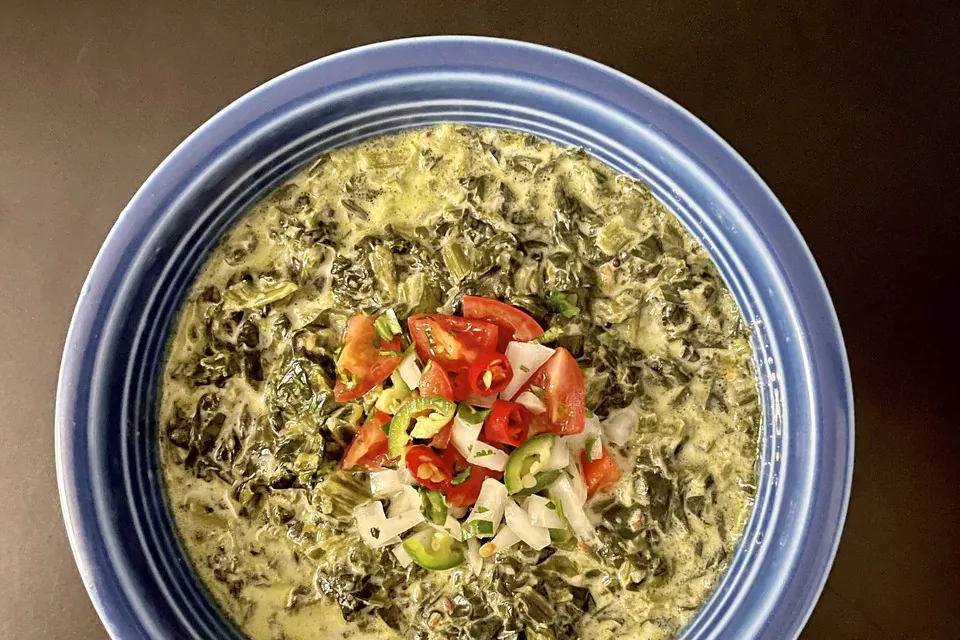
A dish that arrives pale and thick and glossy reads as a cream dish to anyone walking a serving line. On this menu that appearance is usually coconut, and the dish name tells you so before you have to ask.
Eleven of the twelve listings that say cream mean coconut
The storefront runs to thirty-six listings covering thirty distinct dishes, because several dishes appear more than once in different serving shapes. Run the word cream and the word milk across all thirty-six and twelve listings come back. On eleven of those twelve the phrase is coconut cream or coconut milk.
That leaves exactly one. It is the Cucumber Raita, and its own first line reads whole cream yogurt, cucumber and roasted cumin. The exception names itself in the same sentence that creates it.
| What the word is | Listings |
|---|---|
| Cream or milk, coconut | 11 |
| Cream, dairy | 1 |
| Named with lolo, all coconut | 4 |
| Explicit dairy declaration | 2 |
Coconut does the work that dairy cream does in a lot of other kitchens, and it does it because that is how the cuisine has always been cooked. Chand wrote the family recipes down. He did not rebuild them for an office audience.
Where the dairy actually is
Across the whole storefront, two listings carry an explicit dairy declaration. Both of them are yogurt dishes. The Cucumber Raita is whole cream yogurt with cucumber and roasted cumin. The Pakora Karhi is a yogurt and lentil curry topped with fritters. Both carry Indian names, and neither of them is one of the coconut cream curries.
One listing runs the other way and says dairy free out loud, on the Bula Prawns. So the menu is not silent on the question. It marks the dairy where the dairy is, it marks its absence once where the kitchen wanted to be emphatic, and it leaves the rest to the ingredient sentence under each dish.
For someone building an order around a dairy restriction, that is a short list to work from and a short question to ask. Read the description, note the two yogurt dishes, and confirm the current detail with the kitchen before the order goes in. Nothing here is dietary or medical advice, and a menu description is not a substitute for talking to the people cooking.
Why the description is the right place to read it
There is a labelling reason the ingredient sentence carries the weight here rather than a summary line. Federal food labelling rules name nine major food allergens, and the tree nut category is one of them. The Food and Drug Administration publishes a questions and answers document on food allergens, now in its fifth edition, and that document sets out which tree nuts it treats as major food allergens in a single table. The table names twelve, from almond through to walnut. Coconut is not one of them.
The same guidance says what happens to anything left off that table. It stays in the ingredient list under its ordinary name, and it does not belong in a Contains statement. Applied to this kitchen, that is exactly where Curryous puts it. Coconut appears in the dish description, and on several dishes it appears in the dish name as well. If you are planning around coconut for any reason, the description is the line to read, and on this menu it is unusually easy to read.
How the vegan and vegetarian marks fall
The plant side of this list is not a corner of it. Of thirty-six listings, seventeen carry a vegan mark and six carry a vegetarian one. There is a vegetarian tasting menu that bundles butternut squash curry, jackfruit masala and Fiji Dhal together with rice, pooris, raita and pickles, which is a full plate rather than a set of sides. Several of the dishes inside it carry the vegan mark in their own right.
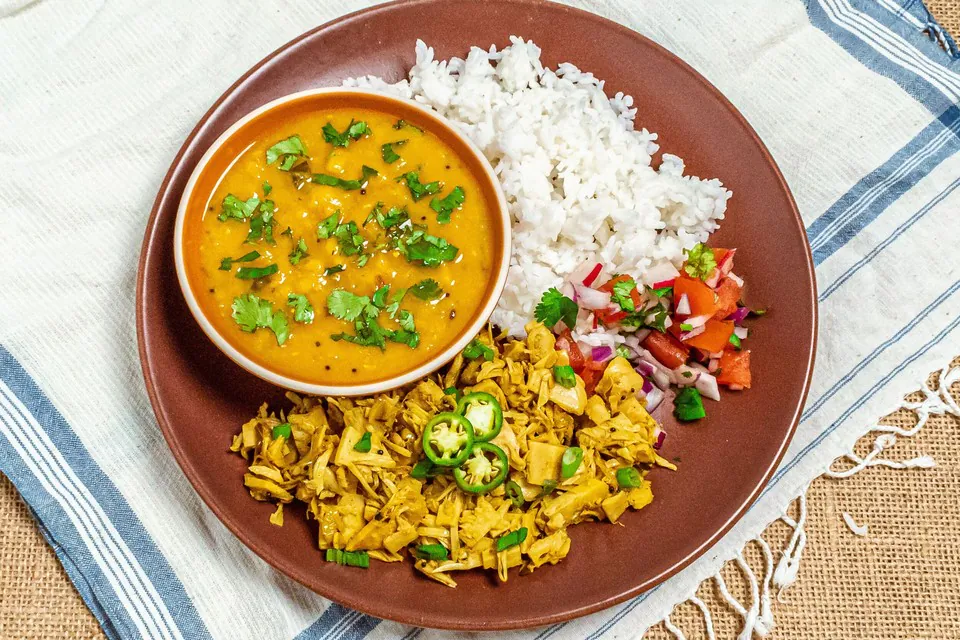
The other side of the count is worth knowing too. Twelve listings carry no diet word at all, and every one of them is a meat or a seafood dish. The marks land on the dishes where the question comes up and stay off the dishes where it does not, so a blank line reads as an answer.
If you are ordering for a room that splits, this is the shape you want. You can build a plant-heavy spine out of the dhal, the jackfruit, the spinach, the black eyed peas, the green beans and the butternut squash, then add one or two meat or fish dishes for the people who want them, rather than running two separate briefs. Our vegan office catering and vegetarian office catering guides cover how to size that split.
What arrives as the starch
Nearly every listing that names a starch names a grain or a flatbread: rice, roti, poori. One names something else. The Ika Vakalolo arrives with steamed cassava, which is a root rather than a grain, and the Taro Curry is a root cooked as the dish itself.
That split is the Indian half and the Fijian half showing up on the plate. It is worth a moment of planning because the two behave differently on a serving line. Rice and flatbread are familiar and will be taken by nearly everyone. Cassava and taro are dense, filling and unfamiliar to most office rooms, so they do better as one interesting thing on a table than as the only starch. Order both if the room is adventurous, and lead with rice if it is not.
Where to read the menu
Curryous publishes its offer in two places and they do different jobs. The online storefront is the dish-level list, with a description under every item, and it is the one this guide has been counting. The sample menus are the event-level view, one for corporate events and one for reception events, plus a featured list that runs as a single open column.
Read the storefront when you want to know what is in something. Read a sample menu when you want to know the shape of a served event, because those are the pages that show a salad, appetisers, mains, accompaniments and a dessert laid out as courses. The reception list runs further into service territory, with hors d’oeuvres, a dessert station and a full bar. The corporate list is the tighter one and is closer to what an ordinary office lunch actually needs.
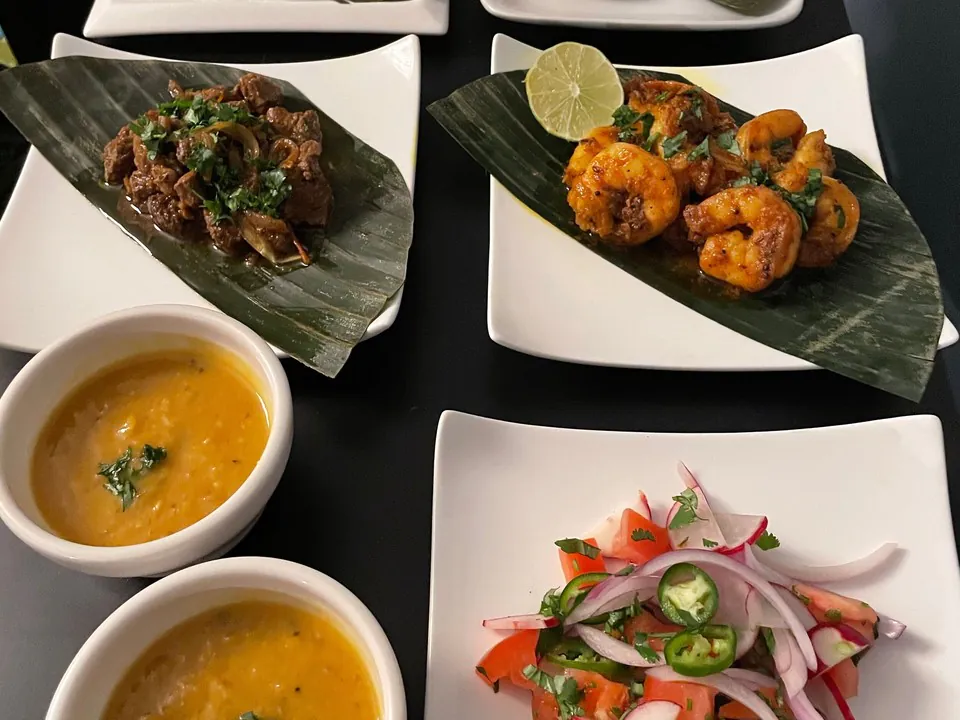
One more thing sits at the top of every sample menu, in the same words each time. Fijian-Indian is the specialty, and the kitchen also offers Italian, American and Mediterranean for events, with sample menus on request. A kitchen that names its specialty and then names its alternatives in the same breath has made your first planning conversation shorter. If the brief is mixed, say so at the start.
How to order Curryous catering for an office
Direct is the simplest route for a small order. The storefront lists the dishes with their descriptions, and the contact page reaches the kitchen for anything that needs an event menu rather than a list of items. Because the heat level is set per event, a short conversation does more here than a long order note.
Through Zerocater, the Curryous page carries the current menu and a live quote, and the order sits alongside every other kitchen your office already uses, on one invoice. How it works covers the mechanics. For a Bay Area office running a rotation rather than a one-off, the Indian catering directory for San Francisco shows what else is available in the same lane.
Whichever route you take, the ordering advice from the counts above is short. Build the spine out of the marked plant dishes, add one coconut cream dish because it is the thing this kitchen is for, keep the two yogurt dishes as a known quantity rather than a surprise, and set the heat deliberately instead of accepting a default.
Curryous and Zerocater
A kitchen like this one is the reason the Zerocater network is built the way it is. Curryous runs one kitchen, cooks one regional cuisine, and does no marketing an office manager would ever trip over. Putting it on the same account as the sandwich order and the taco order is what makes it orderable on a Tuesday rather than only for an occasion.
It also fits a rotation. Most office lunch lists cycle the same handful of cuisines, and this one lands outside all of them without costing you the people with restrictions. CaterAi builds the rotation, keeps track of what has already been ordered, and pulls this kind of kitchen in at the point where variety actually matters. Our Indian corporate catering guide covers the wider category, and the dairy-free office catering guide covers ordering around dairy in general.
Menus, dishes and serving formats change. This guide describes how the Curryous menu is written rather than what is on it this week. For the current menu and a live quote, use the Curryous page on Zerocater, and confirm the current detail with the kitchen before you order for anyone with a dietary requirement.
Curryous catering FAQ
What kind of food is Curryous catering?
Fijian-Indian, cooked out of one San Francisco kitchen. The food comes from the Indo-Fijian community, so the list carries Indian dishes and Fijian dishes side by side and names both in their own languages. You will see masala, dhal, roti and samosa on one line, and lolo, tarkari, tavioka and ika on the next. The operator glosses the Fijian words itself, either in the dish description or in the page address, so you do not need the language to read the menu.
Does Curryous catering have dairy-free options?
The storefront marks dairy where dairy is present. Across thirty-six listings, two carry an explicit dairy declaration and both of those are yogurt dishes. The cream in most of the rest is coconut, and the dish description names it. Read the description rather than the look of the dish, then confirm the current detail with the kitchen before you order for someone who needs it. Nothing here is dietary or medical advice.
What does lolo mean on the Curryous menu?
Lolo is the Fijian word for coconut cream, and the menu uses it the way a kitchen uses any ingredient word. Every listing that carries lolo in its name is built on coconut cream, and the operator confirms it in the description. The Ika Vakalolo makes the point on its own: the dish description names coconut cream, and the page address for that dish spells the same thing out in English.
Does Curryous catering have vegan and vegetarian options?
A large share of the list carries one of the two marks. Of thirty-six storefront listings, seventeen carry a vegan mark and six carry a vegetarian one. There is also a vegetarian tasting menu that bundles several of them. That is a count of what the menu marks, not a dietary guarantee, so call the kitchen with the specific requirement before you order.
Can Curryous adjust the spice level for an office?
Yes, and the operator publishes it as part of how an event gets planned. Curryous grinds its own masalas, and the founder sets the heat and spice level per dish with you when the event is booked rather than leaving it at a house default. For a mixed room that is worth using. Ask for the heat to be pulled back on the dishes that will feed the most people, and keep the chutneys and pickles on the side so anyone who wants more can add it.
Does Curryous cook anything other than Fijian-Indian food?
The operator says so at the top of every sample menu it publishes. Fijian-Indian is the specialty, and Italian, American and Mediterranean are offered alongside it for events, with sample menus available on request. If your brief is a mixed one, say so early. Naming the alternative up front is a convenience, not a substitution.
How do you order Curryous catering?
Two routes. Direct, through the operator’s own site, where the online storefront lists the dishes and the sample menus show how a full event is put together, or by contacting the kitchen for an event menu. Or through Zerocater, where the Curryous page carries the current menu and a live quote, and the order sits alongside every other kitchen your office uses.
Is Curryous a good fit for an office lunch?
It fits a Bay Area team that wants one kitchen to cover a plant-heavy room and a meat-eating room from the same order, without running two separate briefs. The list leans hard toward vegetables and pulses, the dairy is marked where it exists, and the heat is set per event rather than per recipe. For a recurring rotation across several kitchens, CaterAi plans it.