Forty boxed lunches arrive at the office on time, and the bag holds no forks. The kitchen did not forget. In New York City, California, Washington and the District of Columbia, a restaurant may hand out single-use utensils only when the customer asks for them, and the order form you used defaulted to none.
This guide reads the four statutes side by side. Each one keeps a different list of items out of a takeout or delivery order, and each one allows the same thing in their place: a self-serve dispenser. The office answer is short. Put the headcount in the request, name each item, and keep a caddy at the end of the buffet. A managed office lunch catering service sets the table as part of the delivery; this guide is for the orders you place yourself.
In this guide
- Four laws, one default
- What each one counts as the stuff
- Where the wrapped kit went
- The dispenser every law allows
- Does a catering order count?
- How to order so the table is set
- The container itself
Four laws, one default
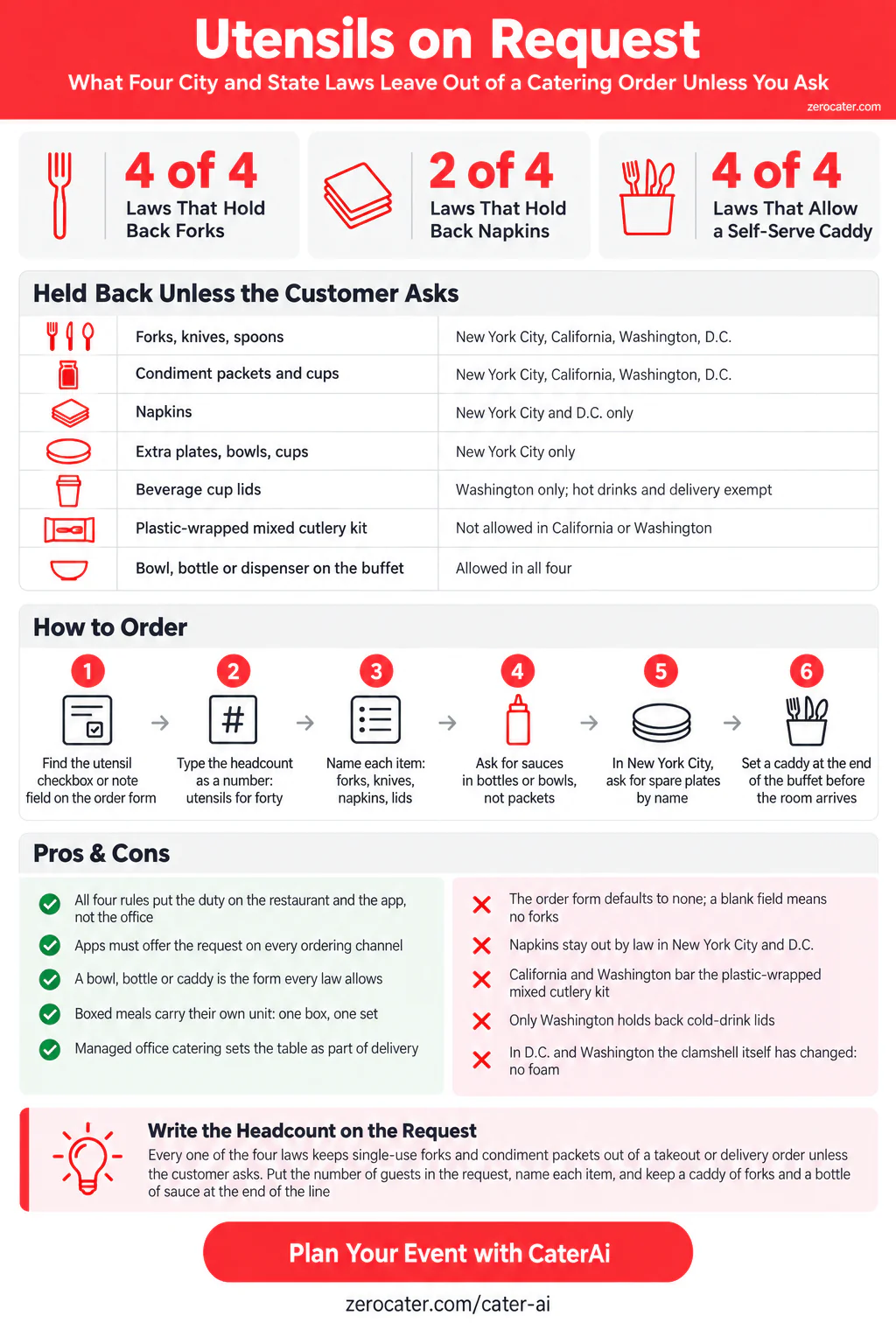
Four legislatures wrote the four rules, and their operative sentences land in the same place. New York City’s section 16-402, added by Local Law 17 of 2023 and known around the city as “Skip the Stuff”, tells a food service establishment not to provide eating utensils, condiment packets, napkins or extra eating containers to a take-away customer “unless such customer requests” them, whether the food goes out the door in the customer’s hand or through a courier or a delivery app. California’s Public Resources Code section 42271 says a food facility shall not provide a single-use foodware accessory or a single-use condiment “unless … requested by the consumer”. Washington’s RCW 70A.245.080 lets a food service business hand over utensils, straws, condiment packaging and cup lids “only after affirming that the customer wants the item or items”. The District’s D.C. Code 8-1533(e) says take-out and delivery orders shall not include accessory ware “unless specifically requested by the customer in person, on the phone, or online”.
| Where | The rule | Who it is written for | The customer’s word |
|---|---|---|---|
| New York City | Administrative Code section 16-402, Local Law 17 of 2023 | The food service establishment, the courier and the delivery app | “unless such customer requests” |
| California | Public Resources Code 42270 to 42273 | The food facility and the third-party delivery platform | “unless … requested by the consumer” |
| Washington | RCW 70A.245.080 | The food service business | “only after affirming that the customer wants the item” |
| District of Columbia | D.C. Code 8-1533(e) | The food service entity and any third-party ordering platform | “unless specifically requested by the customer in person, on the phone, or online” |
Read the third column again. Each rule is written for the business that sells the food and, in three of the four, for the platform that takes the order. New York City requires the app’s default to be that nothing is requested, and California says that when a consumer selects nothing, nothing is provided. The office is the customer in each of these sentences, and the customer’s job is to ask.
What each one counts as the stuff
The lists differ more than the headlines suggest. New York City names four kinds of item: eating utensils (a knife, fork, spoon or chopsticks), condiment packets, napkins and extra eating containers, meaning an empty plate, bowl, cup or lid that is not holding the customer’s food. California names seven kinds of single-use foodware accessory, utensils, chopsticks, condiment cups and packets, straws, stirrers, splash sticks and cocktail sticks, and adds any standard condiment packaged for single use, from ketchup and soy sauce to salt and sugar. Washington names four: utensils, straws, condiment packaging and beverage cup lids. The District defines accessory disposable food service ware as anything “that is not used to hold or contain food” and lists straws, utensils, condiment cups and packets, cup sleeves and napkins.
| Held back unless requested | New York City | California | Washington | D.C. |
|---|---|---|---|---|
| Forks, knives, spoons | Yes | Yes | Yes | Yes |
| Chopsticks | Yes | Yes | “Utensils”, type not stated | “Utensils”, type not stated |
| Condiment packets and cups | Yes | Yes | Yes | Yes |
| Napkins | Yes | Not listed | Not listed | Yes |
| Straws and stirrers | Separate rule, section 16-401 | Yes | Yes | Yes |
| Beverage cup lids | Not listed | Not listed | Yes, except hot drinks and delivery orders | Not listed |
| Cup sleeves | Not listed | Not listed | Not listed | Yes |
| Extra plates, bowls and cups | Yes | Not listed | Not listed | Not listed |
Three cells matter to an office. Two of the four places, New York City and the District, hold napkins back by law; California and Washington leave them off the list. Only New York City holds back extra plates and bowls. Only Washington holds back cup lids, and even there a hot drink or a delivery order comes with its lid. Forks and condiment packets are on all four lists, so those are the two items you should expect to be missing anywhere.
Where the wrapped kit went
Two of the statutes also change the shape of what arrives. California’s section 42271(b) says single-use accessories “shall not be bundled or packaged in a manner that prohibits a consumer from taking only the type of single-use foodware accessory or standard condiment desired”. Washington’s rule says utensils “may not be bundled or packaged in plastic in such a way that a customer is unable to take only the type of single-use utensil or utensils desired without also taking a different type”. The familiar plastic sleeve holding a fork, a knife, a spoon and a napkin is that package.
So in those two states, a kitchen that honours your request for forty sets may send forty forks and forty knives counted into separate bags. Nothing is wrong with the order. It needs a caddy, or two trays, at the end of the buffet line, and someone to set them out before the room arrives.
The dispenser every law allows
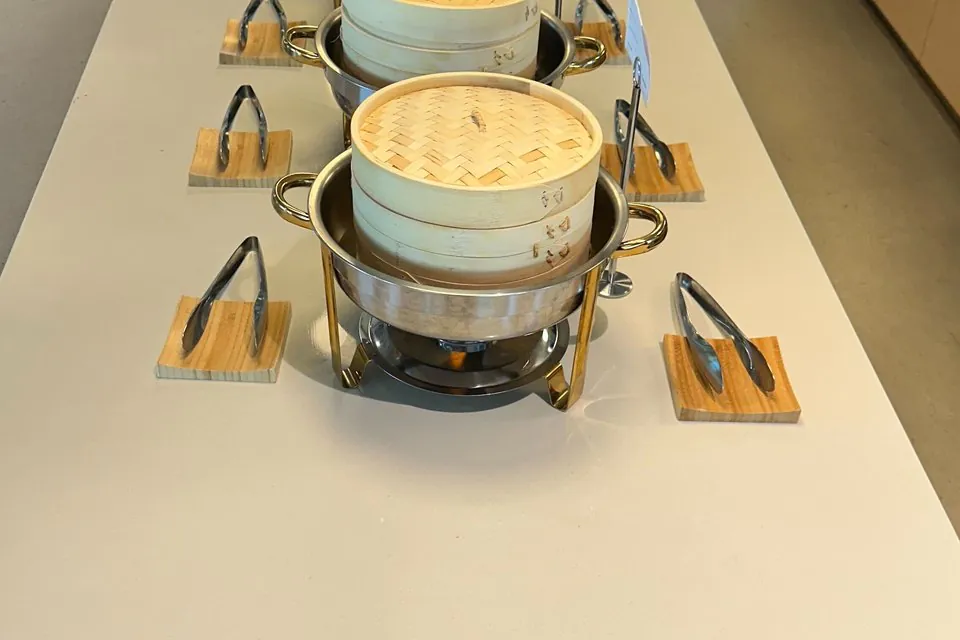
Each of the four statutes carves out the same form. California’s section 42271(f) and (g) allow unwrapped accessories in “refillable self-service dispensers that dispense one item at a time” and standard condiments in bulk dispensers, and the statute says a food facility “is encouraged to use bulk dispensers for the condiments rather than condiments packaged for single use”. Washington allows utensils, straws, condiments and lids “using cylinders, bins, dispensers, containers, or other means” at the customer’s choice. The District allows accessory ware “only upon request by the customer or at a self-serve station”. New York City’s sanitation department states the same carve-out in its business guidance: the restrictions do not apply to self-serve stations inside the food service establishment.
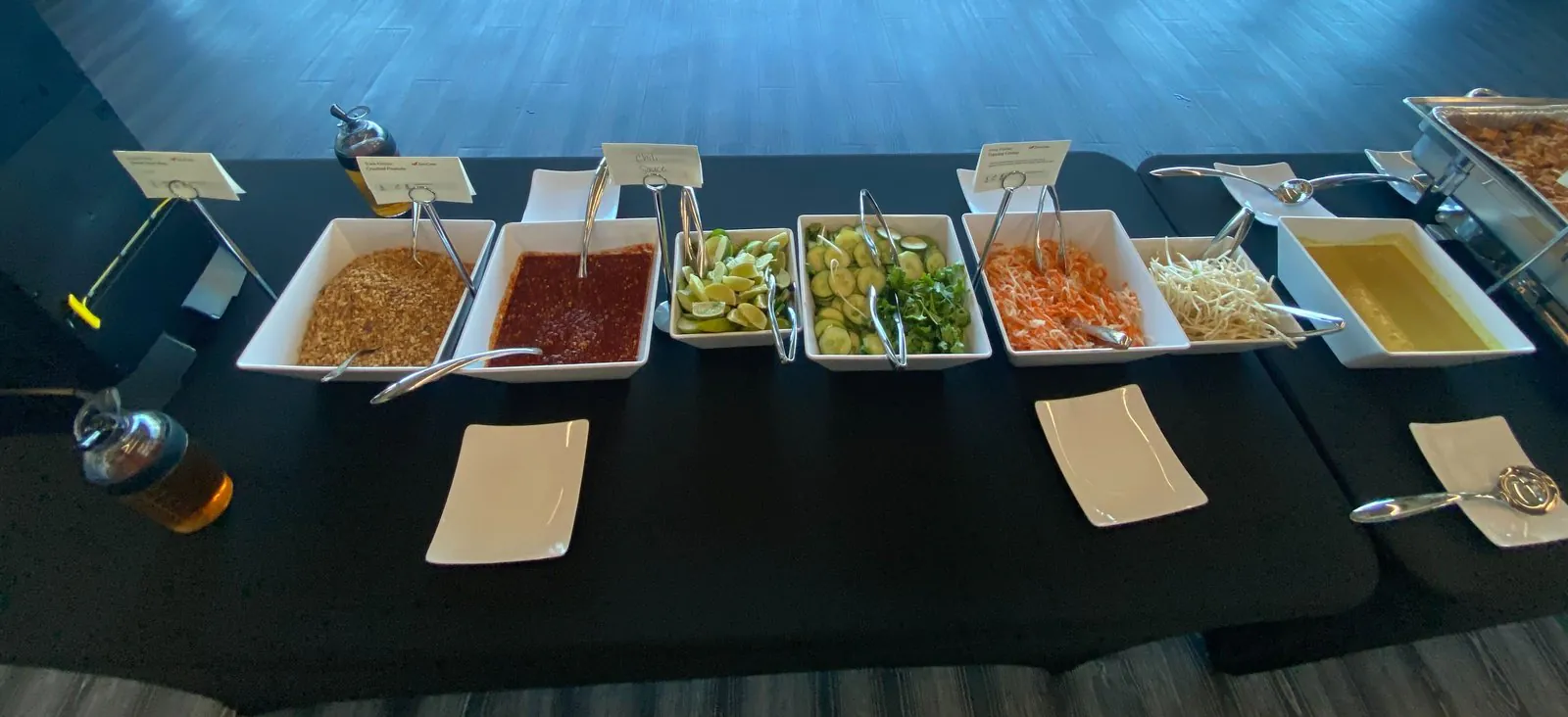
The legislatures wrote that carve-out for the counter, and it describes the office buffet. A bowl of sauce with a spoon in it, a bottle of hot sauce, a napkin dispenser and a caddy of forks at the end of the line are the dispenser the statutes allow, and they replace a hundred packets with four containers. For a recurring lunch, the caddy is a one-time purchase. Our party tray guide covers the serving side of a shared tray, and the Earth Day catering page lists partners that pack in compostable ware by default.
Does a catering order count?
The four statutes describe their reach in their definitions, and the definitions are worth reading before you assume anything about a delivered office lunch. New York City defines take-away as “food or beverage provided by a food service establishment to be consumed off the premises”, which is what a delivered lunch is. The District’s rule names take-out and delivery orders directly, and its food service entity definition closes with “other entities selling or providing food within the District for consumption on or off the premises”. Washington’s food service business definition lists “home delivery services, delivery services provided through an online application, and business or institutional cafeterias” alongside restaurants.
California is the one to read twice. Its definition of a food facility, in Health and Safety Code section 113789, lists a “catering operation” by name. Its operating sentence in section 42271(a), though, is written for a food facility “for on-premises dining or when using a third-party food delivery platform”. Whether a given direct catering order sits inside that sentence is the restaurant’s question to answer with its own counsel. The planning fact for the office is the same either way. The kitchen built its order form around the rule, the default is none, and the request costs you one line.
How to order so the table is set
The request has to be explicit, and in three of the four places it has to be made through whatever channel took the order. New York City requires the app to offer the choice on every ordering method, phone, internet or mobile, with the default set to none. The District requires the option “across all ordering platforms, including digital platforms, telephone, and in-person”. California requires the platform to offer the option and the food facility to list which accessories and condiments it has. So look for the checkbox, the free-text field or the question on the phone, and answer it with numbers.
| What you want on the table | What to put in the request |
|---|---|
| Forks and knives for everyone | The headcount, as a number: utensils for forty |
| A wrapped set per person | In California and Washington, ask for forks and knives counted out and bring the caddy; the mixed plastic-wrapped kit is the bundle both statutes describe |
| Napkins | Ask in all four places; two of the four hold them back by law and kitchens differ elsewhere |
| Sauces and dressings | Ask for bottles or bowls rather than packets; California’s statute encourages the dispenser |
| Spare plates for a shared tray | In New York City, say so; an empty plate is an extra eating container |
| Lids for the drinks | In Washington, ask for cold-drink lids; hot drinks and delivery orders come with them |
Boxed meals change the arithmetic. Each box is one person’s lunch in one sealed container, and on Zerocater’s boxed meal catering page the cutlery sits beside the main inside the box. A buffet, by contrast, needs one fork per guest from a separate bag plus the serving tongs, so the headcount matters more there. Our guide to boxed lunches versus buffets compares the two formats, and last-minute office catering covers the order you place at ten in the morning, which is the one most likely to arrive without forks.
Plan office lunch catering with CaterAi
The container itself
Two of the four jurisdictions also reach the container the food arrives in, which changes what the office throws away. Washington’s RCW 70A.245.070 prohibits the sale and distribution of expanded polystyrene food service products, including food containers, plates, clamshells and hot and cold beverage cups. The District’s chapter on disposable food service ware bars a food service entity from selling or providing food in expanded polystyrene, and section 8-1533(c) goes further: food and drink go out “in disposable food service ware” only when that ware is compostable or recyclable.
For an office in Seattle or Washington, D.C., that means the clamshell is already paper, fibre or a recyclable plastic, and the bin plan follows from it. Our older guide to sustainable catering practices covers the composting side. The four Zerocater city pages, New York City, San Francisco, Los Angeles, Seattle and Washington, D.C., list the catering partners who deliver under these rules every day.
Where Zerocater fits
The four statutes moved the default at the restaurant’s counter and in the delivery app. A managed office catering program never relied on that default. Zerocater’s FAQ describes each meal as delivery and setup “with plates, utensils, and napkins provided”, presented family-style unless the office asks for something else, so the table is set when the room arrives. For ongoing office catering, Zerocater manages the rotation across its local catering partners, and how it works covers the ordering side.
For a single lunch, CaterAi drafts a menu from a plain description of the event. The headcount you give it is the same number to write on the utensil line, and the same number of forks to count into the caddy.
Plan office lunch catering with CaterAi
Frequently Asked Questions
Do I have to ask for forks with an office catering order?
In New York City, California, Washington and the District of Columbia, a restaurant or delivery app may hand out single-use utensils only when the customer asks. Each law also lets the kitchen set out a self-serve dispenser instead. For an order you place yourself at a counter or in an app, type the headcount into the request and name the items. A managed office catering service that sets up the meal brings the plates, utensils and napkins as part of the setup.
Are napkins included in a catering order?
It depends on the city. New York City’s section 16-402 and the District’s accessory-ware definition both list napkins, so there they stay out of a takeout or delivery order unless requested. California’s list of single-use foodware accessories and Washington’s optional serviceware list do not name napkins. Kitchens differ, so ask for them everywhere.
Why did the utensils arrive loose instead of in a wrapped kit?
California and Washington both say utensils may not be bundled so that a customer who wants one type has to take another. A plastic-wrapped kit with a fork, a knife and a spoon is that bundle. Expect loose forks and knives, counted out, and put a caddy at the end of the buffet.
Can I ask for bottles of ketchup instead of packets?
Yes, and California’s statute encourages the kitchen to use bulk dispensers rather than single-use packets. Washington allows condiments in dispensers or containers at the customer’s choice, New York City exempts self-serve stations, and the District allows accessory ware at a self-serve station. A bowl or a bottle on the buffet is the form every one of the four laws allows.
Does the law apply to the office or to the restaurant?
The duty sits with the food business and, where one is involved, the delivery platform. New York City’s rule is written for the food service establishment, the courier and the app. California’s is written for the food facility and the third-party platform. Washington’s is written for the food service business. The District’s is written for the food service entity. The office’s only job is to make the request.
What about extra plates, bowls and cups?
Only New York City’s section 16-402 lists extra eating containers, meaning an empty plate, bowl, cup or lid that is not holding the food. If a New York office wants spare plates for a shared tray, the order has to say so. Washington’s list reaches beverage cup lids, with an exemption for hot drinks and for delivery orders.