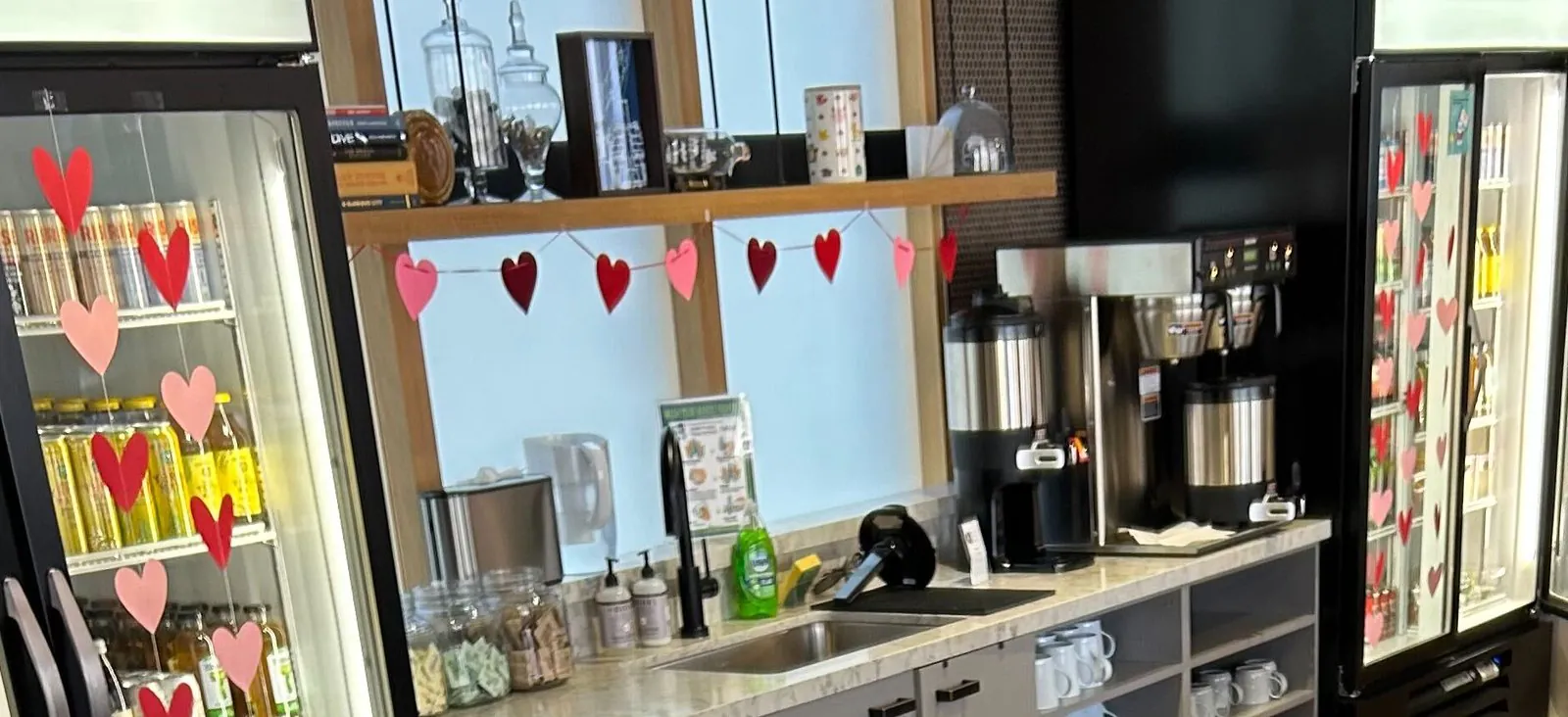
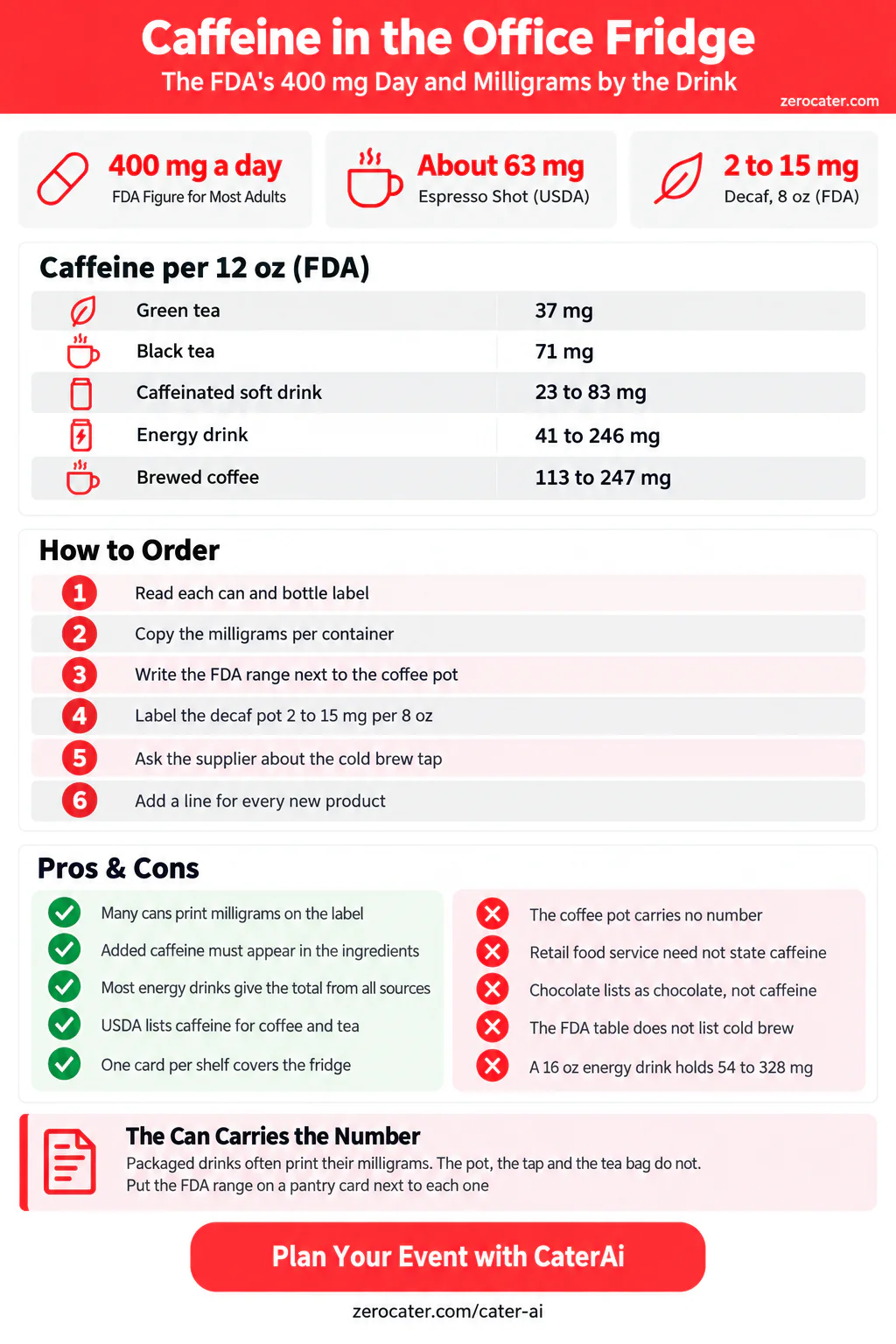
Open the fridge in a stocked office pantry and you find cans of soda, sparkling tea, a cold brew or two and an energy drink at the back. Turn around and there is a coffee pot. Each of those carries caffeine, and the amounts are far apart. The FDA puts a 12-ounce green tea at 37 milligrams and a 12-ounce brewed coffee at 113 to 247.
The FDA’s figure of 400 milligrams is a day’s total, and the drinks your team picks add up toward it. This guide sets out the FDA and USDA numbers drink by drink, explains which containers print a number and which do not, and shows how to put the missing numbers on a pantry card.
In this guide
- The FDA’s 400 milligrams
- Milligrams per 12 ounces, drink by drink
- Espresso, drip and tea in USDA data
- The can carries the number, the pot carries none
- Cold brew, decaf and the snack shelf
- Writing the pantry card
The FDA’s 400 milligrams
The FDA’s consumer page Spilling the Beans: How Much Caffeine is Too Much? gives the number. For most adults, the agency has cited 400 milligrams a day as an amount “not generally associated with negative effects”. It translates that into about two to three 12-ounce cups of coffee.
The same page says people vary in how strongly they react to caffeine and how fast their bodies clear it. Some medications and conditions raise the sensitivity. For anyone who is pregnant, trying to become pregnant or breastfeeding, the FDA recommends talking to a health care provider about caffeine. Our guide to pregnancy and office catering covers the food side of that order.
So count toward 400 across the whole day, coffee at home included. The pantry can show each person what a can or a mug holds, and each person keeps their own count.
Milligrams per 12 ounces, drink by drink
The FDA prints its figures per 12 fluid ounces, the size of a standard can and a desk mug. We divided 400 by each figure to show how many 12-ounce servings of one drink reach the day’s total.
| Drink (FDA, per 12 oz) | Caffeine | 12 oz servings to reach 400 mg |
|---|---|---|
| Caffeinated soft drink | 23 to 83 mg | 4.8 to 17.4 |
| Green tea | 37 mg | 10.8 |
| Black tea | 71 mg | 5.6 |
| Coffee, regular brewed | 113 to 247 mg | 1.6 to 3.5 |
| Energy drink | 41 to 246 mg | 1.6 to 9.8 |
The ranges are wide for a reason. Brands and brews differ, and the FDA adapted its table from a published study of brand-specific values. A 12-ounce soft drink can hold 23 milligrams or 83. Brewed coffee runs from 113 to 247, so the count to 400 runs from under two mugs to three and a half.
Container size moves the number too. The FDA gives a separate range for energy drinks in 16-ounce cans: 54 to 328 milligrams. A 16-ounce can at the top of that range holds 82 percent of the FDA’s daily figure on its own.
Espresso, drip and tea in USDA data
The FDA page points readers to USDA FoodData Central for more figures. USDA lists caffeine per 100 grams of each drink and the weight of a standard serving, so we multiplied one by the other.
| Drink (USDA FoodData Central) | Serving | Caffeine |
|---|---|---|
| Brewed coffee | 8 oz cup | about 95 mg |
| Espresso | 1 oz shot | about 63 mg |
| Black tea, brewed | 8 oz cup | about 47 mg |
| Green tea, brewed | 1 cup | about 29 mg |
An espresso shot holds about 63 milligrams, less than an 8-ounce cup of drip at about 95. A double shot lands near the drip cup. So a latte made with one shot holds less caffeine than an 8-ounce mug of drip, and the shot count on the order decides the rest.
USDA and the FDA measure different samples, so their figures do not match to the milligram. Use one source per line on the card, and say which one.
The can carries the number, the pot carries none
The labeling rules explain the gaps. Under FDA rules, a packaged food must list caffeine in its ingredients when caffeine is added as a stand-alone ingredient. The amount is voluntary. The FDA notes that many packaged drinks and supplements print the milligrams on the label by choice, and that most energy drinks sold in the US give the total from all sources, guarana included.
Restaurants and other retail food establishments are not required by law to tell you how much caffeine is in what they serve. The FDA’s advice is to ask. In an office, that covers the coffee pot, the espresso machine, the cold brew tap and the box of tea bags. Nothing on them gives a milligram figure.
So the can carries the number and the pot carries none. The drink most of your team pours, a mug of brewed coffee, is the one with no figure in sight. A pantry card puts the FDA range next to the pot, and that is the one number the fridge cannot show.
Plan office coffee with CaterAi
Cold brew, decaf and the snack shelf
Cold brew. The FDA table does not list cold brew as its own drink, and no figure from the FDA or USDA covers it. If the cold brew comes in a can, read the label and copy the milligrams. A cold brew on a tap or in a keg has no label at the point of pour. Ask the supplier for the milligrams per serving and write it on the card. Our older post on office drinks on tap covers the taps themselves.
Decaf. The FDA says decaf is not caffeine-free. Decaf coffee typically has 2 to 15 milligrams in an 8-ounce cup. Label the decaf pot with that range, so the person who avoids caffeine knows what the cup holds.
The snack shelf. The FDA lists protein bars, ice cream and chewing gum among products that can carry added caffeine. Chocolate is a separate case. When a snack contains chocolate chips, the label lists the chocolate and not the caffeine inside it, so a chocolate bar does not say “caffeine” on its back.
Powders. The FDA warns that toxic effects can appear with rapid intake of around 1,200 milligrams of caffeine, less than half a teaspoon of the pure powder. Keep bulk caffeine powder and concentrates off a shared pantry shelf, where a person has to measure a serving by hand.
Writing the pantry card
One card per shelf or per station does the job. List each drink, the milligrams per container and where the number came from. Here is a template that uses only the figures in this guide.
| On the shelf | Where the number comes from | What the card says |
|---|---|---|
| Canned or bottled drink with milligrams on the label | The label | Copy the label: milligrams per container |
| Can with caffeine in the ingredients and no amount | Nothing printed | Contains caffeine, amount not listed |
| Drip coffee pot | FDA range for 12 oz brewed coffee | 113 to 247 mg per 12 oz mug |
| Decaf pot | FDA range for 8 oz decaf | 2 to 15 mg per 8 oz cup |
| Espresso machine | USDA, one fluid ounce | About 63 mg per shot |
| Black or green tea bags | FDA, per 12 oz | Black about 71 mg, green about 37 mg |
| Cold brew tap or keg | The supplier | Ask for milligrams per serving |
Write milligrams per container, not per 12 ounces, for anything that does not come in 12 ounces. A 16-ounce can and an 8.4-ounce can of the same drink are different lines. When the restock brings a new product, read its label before it goes in the fridge and add a line.
Group the fridge by strength if you have the space: drinks with no caffeine on one shelf, tea and soft drinks on the next, coffee drinks and energy drinks on the top. A person reaching for a late-afternoon can then sees the difference before they open the door.
For the beans behind the pot, our guide to office coffee by the cup works out how much ground coffee an office uses each week. For tea at a meeting, the tea catering page lists partners who deliver it.
Where Zerocater fits
Zerocater runs office coffee and pantry programs as part of its corporate cafeteria service, from stocked micro-kitchens with glass-front fridges to cold brew taps and a managed barista bar. Our guide to designing a company cafeteria plan covers where drinks fit in the larger pantry. For recurring meals, Zerocater manages office catering across local catering partners, and how it works covers the ordering side.
For a single meeting, CaterAi drafts a menu from a plain description of the event, with coffee and tea on the same order as the food.
Plan office coffee with CaterAi
Frequently Asked Questions
How much caffeine does the FDA say is fine in a day?
For most adults, the FDA has cited 400 milligrams a day as an amount “not generally associated with negative effects”. The agency puts that at about two to three 12-ounce cups of coffee, and it adds that people differ in how they react to caffeine and how fast they clear it.
How much caffeine is in a 12-ounce cup of office coffee?
The FDA gives 113 to 247 milligrams for 12 ounces of regular brewed coffee. USDA FoodData Central lists about 95 milligrams for an 8-ounce cup of brewed coffee. The beans and the brew change the number, so a pantry card should show the range.
Does decaf coffee have caffeine?
Yes, a little. The FDA says decaf coffee typically has 2 to 15 milligrams in an 8-ounce cup. Label the decaf pot with that range, not with zero.
Do drink labels have to show the caffeine amount?
No. The FDA requires a packaged food to list caffeine in the ingredients when it is added as an ingredient, and many brands print the milligrams by choice. Restaurants and other retail food establishments do not have to tell you the amount at all.
How much caffeine is in cold brew?
The FDA table does not list cold brew, and the amount depends on the recipe. If the cold brew arrives in a can, read the label. If it comes from a keg or a tap, ask the supplier for the milligrams per serving and write it on the card.
Is caffeine listed on chocolate?
Not always by name. The FDA says that when a food contains an ingredient that has caffeine on its own, such as chocolate chips, the label lists the chocolate and not the caffeine.