to plan your catering
In any office of 30 or more people, you can count on at least four or five distinct dietary needs showing up at the same lunch table. The good news: accommodating mixed dietary needs in a catering order typically adds just $2 to $5 per person, and with the right approach you can cover most restrictions with fewer special items, not more. This guide walks through the most common dietary needs, how they overlap, how to collect the right information from your team, which menu formats cover the widest range, and how to build one efficient order that works for everyone.
In This Guide
- The 8 Most Common Dietary Needs in Office Catering
- The Overlap Math: Which Diets Cover Others
- How to Collect Dietary Information from Your Team
- Menu Formats That Cover the Most Diets
- How to Build One Order That Covers Everyone
- Common Mistakes When Ordering for Mixed Dietary Groups
- How Much More Does It Cost to Accommodate Multiple Diets?
- FAQ
The 8 Most Common Dietary Needs in Office Catering
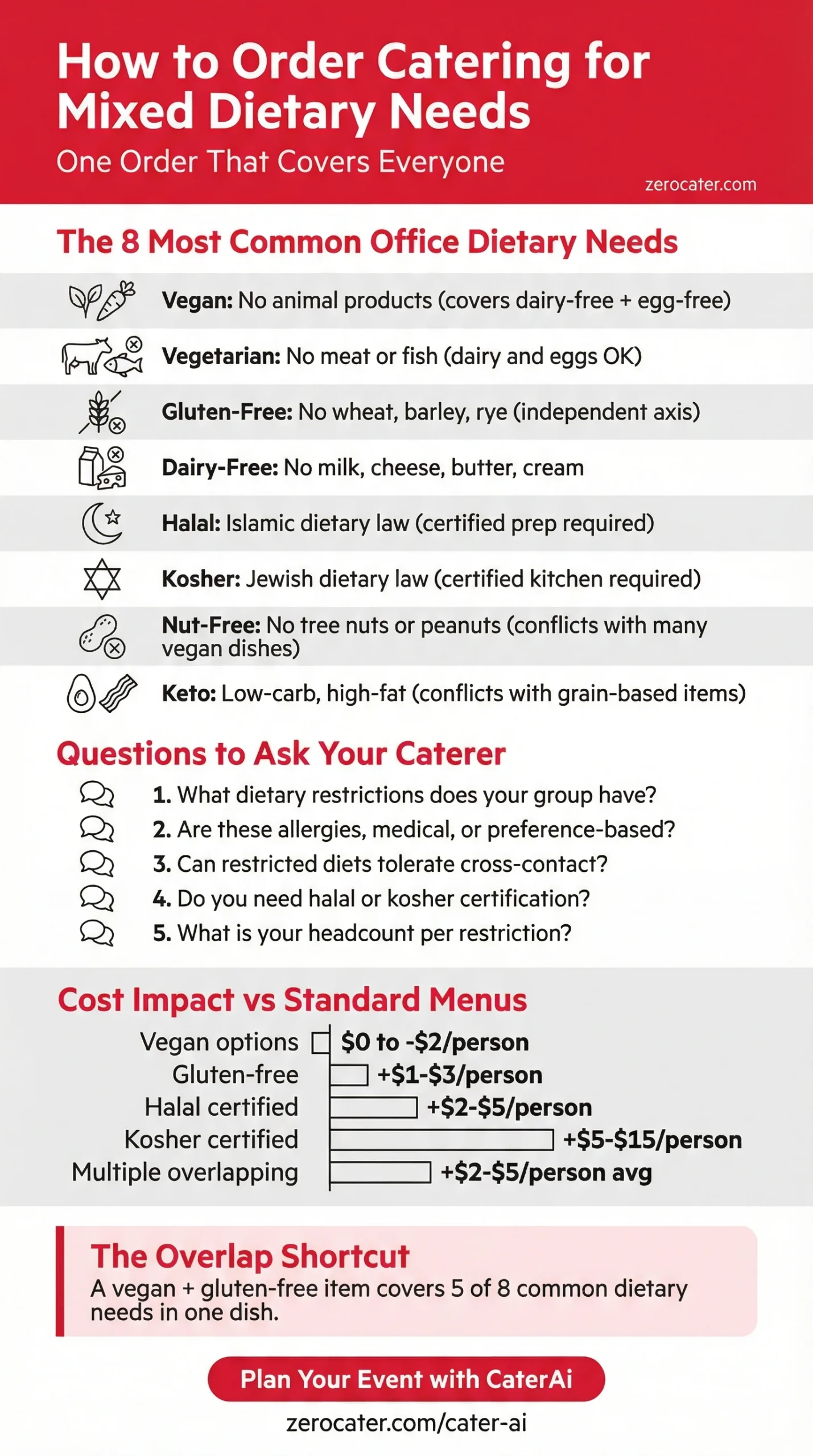
Before you place a catering order for a mixed group, it helps to understand the landscape. These eight dietary categories account for the vast majority of restrictions you will encounter in an office setting.
| Diet | What It Excludes | Common Reason | Est. % of U.S. Workforce |
|---|---|---|---|
| Vegan | All animal products (meat, dairy, eggs, honey) | Ethics, environment, health | 3-6% |
| Vegetarian | Meat and fish (dairy and eggs OK) | Ethics, health, religion | 5-8% |
| Gluten-Free | Wheat, barley, rye, and cross-contaminated grains | Celiac disease, sensitivity, preference | 6-8% |
| Dairy-Free | Milk, cheese, butter, cream, yogurt | Lactose intolerance, allergy | 10-15% |
| Halal | Pork, alcohol, non-halal-slaughtered meat | Islamic dietary law | 1-2% |
| Kosher | Pork, shellfish, mixing dairy and meat, non-kosher preparation | Jewish dietary law | 1-2% |
| Nut-Free | Tree nuts, peanuts, and cross-contaminated items | Allergy (can be life-threatening) | 1-3% |
| Keto / Low-Carb | Bread, pasta, rice, sugar, high-carb foods | Weight management, metabolic health | 5-10% |
Not all restrictions are equal
Religious requirements (halal, kosher) and medical needs (celiac, nut allergy) are non-negotiable. Preference-based diets (keto, voluntary vegetarian) deserve respect but have more flexibility. When building your order, always treat allergy and religious restrictions as hard requirements and build around them first.
The Overlap Math: Which Diets Cover Others
Here is where most office catering orders go wrong: treating every dietary need as a completely separate category. In reality, many diets are subsets of others. Understanding the overlaps is the single most useful thing you can do to simplify your order.
| If You Order This… | It Also Covers These Needs |
|---|---|
| Vegan | Vegetarian, Dairy-Free, Egg-Free |
| Vegan + Gluten-Free | Vegetarian, Dairy-Free, Egg-Free, Gluten-Free (5 of 8 needs in one dish) |
| Vegan + Gluten-Free + Nut-Free | Vegetarian, Dairy-Free, Egg-Free, Gluten-Free, Nut-Free (6 of 8) |
| Halal | Pork-free (partial overlap with Kosher on pork restriction) |
| Kosher | Pork-free, shellfish-free (does NOT automatically cover halal, or vice versa) |
| Keto | Independent axis (conflicts with grain-based vegan and vegetarian items) |
The key insight: A single vegan, gluten-free dish satisfies five of the eight most common dietary needs simultaneously. That is your highest-leverage item when building a mixed-diet order.
Watch for conflicts: Nut-free and vegan frequently clash because many vegan dishes rely on cashew cream, almond milk, or nut-based cheese. Keto conflicts with most grain-based vegan items. Halal and kosher overlap on pork avoidance but diverge on preparation requirements and certification. These conflicts are where you need separate items rather than overlap coverage.
Why Overlap Math Saves Money
Consider a real scenario: you are ordering lunch for 50 people. The dietary survey comes back with 4 vegans, 3 gluten-free, 2 dairy-free, and 1 nut allergy.
Without overlap thinking, you might order 10 separate special meals (one per person with a restriction). That is 10 premium items at $3 to $5 more each, adding $30 to $50 to your order.
With overlap thinking, you order 8 vegan + gluten-free items. Those 8 dishes cover all 4 vegans, all 3 gluten-free people, and both dairy-free employees (since vegan is automatically dairy-free). That is 9 of 10 restricted eaters served by one item type. You only need 1 additional nut-safe item for the nut allergy. Total extra cost: $10 to $15 instead of $30 to $50.
How to Collect Dietary Information from Your Team
You cannot build a smart order without accurate data. The method depends on your group size.
Survey Approach (Teams of 20+)
Send a short survey 5 to 7 business days before the event. Keep it under 2 minutes to complete. A Google Form, Microsoft Form, or even a Slack poll works fine. The goal is to capture restrictions, severity, and any details the caterer needs to know.
Copy-Paste Dietary Survey Template
- Do you have any of the following dietary needs? (Check all that apply): Vegan, Vegetarian, Gluten-Free, Dairy-Free, Halal, Kosher, Nut-Free, Keto/Low-Carb, Other
- Is this due to: Allergy (anaphylaxis risk), Medical condition (celiac, intolerance), Religious requirement, Personal preference
- Severity: Cannot tolerate any trace (strict avoidance needed) / Can tolerate minor cross-contact
- Anything else we should know? (Free text)
Quick Method (Teams Under 20)
For smaller groups, add a one-line question to the meeting invite or event RSVP: “Any dietary preferences or allergies we should know about for catering?” This is the same approach recommended in our board meeting catering guide, which covers discreet dietary collection for formal settings. For groups under 10, a quick Slack message or email is enough.
Maintaining a Standing Dietary Profile
If your team caters regularly (weekly or monthly), collecting dietary info every single time is unnecessary. Build a dietary roster: a simple spreadsheet listing each team member’s restrictions and severity. Update it quarterly and whenever a new hire joins. Zerocater’s managed catering programs track dietary profiles automatically, so your recurring orders always reflect the latest team needs without manual updates.
Menu Formats That Cover the Most Diets
Not all catering formats are created equal when it comes to dietary coverage. The best formats for mixed groups let people self-select from a shared spread, so one setup naturally accommodates many needs. Here is how the most common formats rank.
| Format | Diets Covered Without Modification | Best For | Price/Person |
|---|---|---|---|
| Build-Your-Own Grain Bowl Bar | 7 of 8 (all except kosher-certified) | Teams of 15-50 with 3+ restrictions | $13 – $20 |
| Mediterranean Spread | 6 of 8 (most items naturally vegan + GF) | Mixed teams wanting variety and flavor | $14 – $22 |
| Indian Buffet | 5-6 of 8 (deep vegan tradition, rice-based) | Teams comfortable with spiced cuisine | $14 – $22 |
| Taco/Burrito Bar | 5 of 8 (corn tortillas are GF, beans are vegan) | Casual lunches, all-hands meetings | $12 – $18 |
| Labeled Boxed Lunches | All 8 (each box tailored, but requires multiple SKUs) | Meetings where setup must be minimal | $14 – $22 |
| Standard Buffet (Protein + Sides) | 3-4 of 8 (covers vegetarian, maybe GF) | Simple teams with few restrictions | $15 – $25 |

The winner for mixed teams: build-your-own bars. When people assemble their own plates from a selection of bases, proteins, toppings, and dressings, most dietary needs resolve themselves. Include quinoa or brown rice (GF), grilled chicken and tofu (covers omnivores and vegans), and keep nuts and gluten-containing items in separate, labeled containers. Browse Mediterranean catering and Indian catering on Zerocater for caterers who specialize in these formats.
Dietary-friendly caterers on Zerocater by city
- San Francisco: Saucy Greens (salads and grain bowls), Za’atar Mediterranean (falafel and bowls), Healthy Med by Lale
- New York City: Green Station (plant-forward bowls), Baal Cafe & Falafel, Just Salad
- Austin: Ranch Hand Organic Bowls (organic grain bowls)
- Chicago: Olive Mediterranean Grill, Brazilian Bowl Fresh Grill
Browse the full Mediterranean, Indian, and Mexican catering directories for more options near your office.
How to Build One Order That Covers Everyone
Here is the step-by-step process for turning a mixed list of dietary needs into a single, efficient catering order.
Step 1: Tally Your Restrictions and Group Overlaps
Start with the raw numbers from your survey. Then group them using the overlap logic from the table above. For example, if your 50-person team has 4 vegans, 6 vegetarians, 3 gluten-free, 2 dairy-free, 1 halal, and 1 nut allergy, your grouped tally looks like this:
- Vegan + GF items needed: Covers 4 vegans + 3 GF + 2 dairy-free = up to 9 people served by one item type
- Vegetarian items needed: 6 vegetarians (those not already covered by vegan items)
- Halal items needed: 1 person (confirm if halal-certified prep is required or if pork-free is sufficient)
- Nut-free items needed: 1 person (ensure their items are prepared without nut cross-contact)
- Standard items: Remaining ~33 people
Step 2: Choose Your “Max Coverage” Items
Pick menu items that satisfy the most restrictions at once. A Mediterranean grain bowl with quinoa, roasted vegetables, chickpeas, tahini dressing (no nuts), and no bread hits vegan, GF, dairy-free, vegetarian, and nut-free all at once. That single item type covers nearly every restriction on your list.
Step 3: Apply the Right Ratios
Not everyone with a dietary restriction eats only “their” food. Omnivores happily eat a good grain bowl, and vegetarians will eat vegan dishes. Use these ratios as a starting point:
- 25-30% of total items: Max-coverage (vegan + GF or equivalent)
- 15-20%: Vegetarian (covers vegetarians and flexitarians who grab plant-based items)
- 50%: Standard omnivore items
- Plus individual accommodations for severe allergies or certification-required diets (halal, kosher)
For the 50-person example above: 13-15 vegan+GF items, 8-10 vegetarian items, 25 standard items, 1 halal-specific item, and 1 nut-safe item. For more on the vegan-specific ratios and menu ideas, see our vegan office catering guide.
Step 4: Confirm Details with Your Caterer
Send the caterer your full restriction list, not just “some people are vegan.” Specifically confirm:
- Which items are prepared in a nut-free / gluten-free / allergen-safe environment
- Whether halal or kosher items come from a certified supplier
- How items will be labeled on delivery
- Whether cross-contamination protocols are in place for allergy-level restrictions
The #1 mistake in mixed-diet catering
Ordering a separate special meal for every restriction. A team with 4 vegans, 3 gluten-free, and 2 dairy-free employees does not need 9 special meals. It needs 6 to 8 vegan + GF items that cover all of them at once, plus standard items for everyone else. This approach costs less, simplifies logistics, and avoids singling people out with obviously different plates.
Plan Your Multi-Diet Catering with CaterAi
Common Mistakes When Ordering for Mixed Dietary Groups
- Treating every restriction as a separate order. As covered above, overlap logic reduces the number of special items dramatically. Start with max-coverage items and work outward.
- Assuming vegan automatically means nut-free or gluten-free. Many vegan dishes rely on cashew cream, almond milk, and seitan (pure wheat gluten). Vegan and nut-free are frequently in conflict. Always check ingredients, not just the “vegan” label. See our vegan catering guide for a full list of hidden non-vegan ingredients.
- Not asking about severity. “I prefer not to eat gluten” and “I will have an anaphylactic reaction to trace amounts of peanuts” require completely different levels of accommodation. Your survey must distinguish preference from medical need from life-threatening allergy.
- Defaulting to boring “safe” options for restricted diets. A plain side salad or a bowl of fruit is not a meal. People with dietary restrictions deserve entrees, not afterthoughts. If the vegan option looks noticeably less substantial than the standard option, that is a problem.
- Skipping labels entirely. Unlabeled food forces people to ask, guess, or skip the meal. Use tent cards with standardized icons: V (Vegan), VG (Vegetarian), GF (Gluten-Free), DF (Dairy-Free), NF (Nut-Free), H (Halal), K (Kosher). For more on discreet labeling techniques, see the dietary section in our board meeting catering guide.
- Collecting dietary info the day of the event. Most caterers need 2 to 5 business days of lead time for dietary accommodations. Same-day requests limit your options significantly. Send the survey with the event invite, not the day before.
- Ignoring halal and kosher certification requirements. Halal and kosher are not just ingredient lists. They involve certified preparation methods, dedicated equipment, and supply chain traceability. Simply removing pork from a dish does not make it halal or kosher. If your team includes observant employees, you may need a vendor with proper certification.
How Much More Does It Cost to Accommodate Multiple Diets?
Less than you think. The biggest cost driver in mixed-diet catering is not the food itself but the approach: ordering inefficiently (separate meals for each restriction) costs two to three times more than ordering smart (overlap-based).
| Accommodation | Cost Impact vs. Standard | Notes |
|---|---|---|
| Vegan options | $0 to -$2/person | Plant proteins (chickpeas, lentils, tofu) cost less than meat |
| Gluten-free items | +$1 to $3/person | GF bread, pasta, and baked goods carry a premium |
| Halal-certified | +$2 to $5/person | Certified sourcing adds cost; many Mediterranean caterers are halal by default |
| Kosher-certified | +$5 to $15/person | Requires certified kitchen, dedicated equipment, rabbinical supervision |
| Nut-free preparation | +$0 to $1/person | Minimal cost, mainly requires separate prep area |
| Keto / low-carb | +$1 to $3/person | Extra protein portions, fewer carb fillers |
| Multiple overlapping (smart order) | +$2 to $5/person average | Overlap logic keeps costs down even with 4+ restrictions |
The bottom line: For a typical 50-person order at $18 per person, accommodating 4 to 5 dietary restrictions adds roughly $100 to $250 to the total, not the $500+ that people fear when they hear “we need vegan, gluten-free, halal, and nut-free options.” Smart ordering through overlap logic is the difference.
When a Catering Platform Saves You Money
For teams with three or more dietary restrictions, a catering platform that aggregates multiple vendors in a single order almost always costs less than coordinating separately with two or three caterers. You pay one delivery fee instead of three, the platform handles dietary filtering and labeling, and you spend 15 minutes ordering instead of an hour.
CaterAi is built for exactly this kind of multi-diet ordering. Share your headcount, budget, and the full list of dietary needs. CaterAi builds custom menus from over 1,000 restaurants, automatically filtering for your restrictions. You can chat to swap dishes, adjust portions, or add items. Then check out and Zerocater handles delivery and setup.
For caterer recommendations across different cities and cuisines, see our guides to the best corporate event catering in NYC, San Francisco, Austin, and Chicago. For chain catering options with dietary considerations, check our Panera catering guide and Chipotle catering guide.
Frequently Asked Questions
How do I order catering for a team with multiple dietary restrictions?
Start by surveying your team 5 to 7 days before the event. Group overlapping needs using subset logic: a vegan plus gluten-free item covers vegan, vegetarian, dairy-free, egg-free, and gluten-free diets all at once. Order 25 to 30 percent of total items as these max-coverage options, then fill in the rest with standard items and individual accommodations for severe allergies. Use build-your-own formats like grain bowl bars or Mediterranean spreads, which naturally cover the most diets.
What catering menu formats work best for mixed dietary needs?
Build-your-own grain bowl bars cover the most dietary needs because diners choose their own base, protein, and toppings. Mediterranean spreads with falafel, hummus, and grilled vegetables are a close second since most items are naturally vegan and gluten-free. Indian buffets work well because many dishes are plant-based by default. Taco bars with corn tortillas, beans, and grilled vegetables also cover multiple diets simultaneously.
How much extra does it cost to accommodate dietary restrictions in catering?
Accommodating multiple dietary restrictions typically adds $2 to $5 per person to a standard catering order. Vegan options often cost the same or less than meat-based equivalents. Gluten-free items add $1 to $3 per person. Halal-certified catering adds $2 to $5 per person, and kosher-certified catering adds $5 to $15 per person since it requires a certified kitchen. Smart overlap ordering minimizes the total cost impact.
Should I order separate meals for each dietary restriction in my catering order?
No. Ordering a separate special meal for every restriction is the most common and most expensive mistake in mixed-diet catering. Instead, use overlap logic. A single vegan plus gluten-free item satisfies vegans, vegetarians, dairy-free, egg-free, and gluten-free diets in one dish. A team with 4 vegans, 3 gluten-free, and 2 dairy-free employees does not need 9 special meals. It needs 6 to 8 vegan plus gluten-free items that cover all of them.
How far in advance should I collect dietary information before ordering catering?
For teams of 20 or more, send a dietary survey 5 to 7 business days before the event. Include checkboxes for the 8 most common dietary needs plus a severity question distinguishing allergies from preferences. For smaller groups under 20, add a one-line dietary question to the meeting invite. For teams that cater regularly, maintain a standing dietary roster and update it quarterly or when new hires join.
Can a catering platform handle halal, kosher, and allergy catering requirements?
Yes. Catering platforms like Zerocater aggregate vendors including halal-certified and kosher-certified caterers, along with caterers experienced in allergen management. Using a platform is especially valuable when your team has 3 or more dietary restrictions because the platform handles vendor selection, dietary filtering, and labeling in one order rather than requiring you to coordinate with multiple caterers separately.
What is the best catering option for a team with nut allergies?
Mediterranean catering with tahini-based items (instead of nut-based sauces) is one of the safest options for nut-allergic teams. Mexican catering formats like taco bars and burrito bowls are also naturally low in nut ingredients. Avoid vegan dishes that rely on cashew cream, almond milk, or nut-based cheese. Always confirm with your caterer that items are prepared in a nut-free environment and ask about cross-contamination protocols.
How do I label catering dishes for multiple dietary needs?
Use tent cards or small signs next to each dish with standardized dietary icons: V (Vegan), VG (Vegetarian), GF (Gluten-Free), DF (Dairy-Free), NF (Nut-Free), H (Halal), K (Kosher). List the dish name in large text with dietary markers in a smaller font below. For allergy-level restrictions like nut-free, add a separate allergen callout. For more on discreet labeling in formal settings, see our board meeting catering guide.